Arturo Ferrarin e il volo Roma Tokyo
Contenuto
- Collezione
- MIRABILIA D'ARCHIVIO
- Descrizione
-
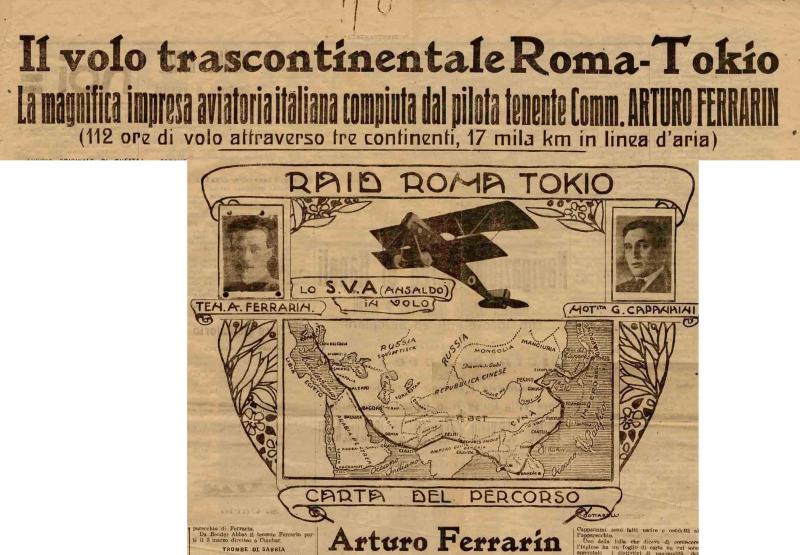
Il raid Roma-Tokyo fu un viaggio aereo compiuto attraverso l'Eurasia, la cui realizzazione fu auspicata da Gabriele D'Annunzio e Harukichi Shimoi, e che venne portato a termine dagli aviatori Guido Masiero e Arturo Ferrarin insieme ai rispettivi motoristi Roberto Maretto e Gino Cappannini. Il raid venne compiuto tra il 14 febbraio e il 31 maggio 1920.
Gabriele D'Annunzio lanciò l'idea del raid Roma-Tokyo nel marzo 1919: essa nacque dall'incontro, durante la Grande Guerra, tra il Vate ed il poeta giapponese Harukichi Shimoi, arruolatosi negli Arditi dell'Esercito Italiano. Il primo, già protagonista del volo su Vienna era inizialmente intenzionato a realizzare l'impresa in prima persona e per tale motivo venne aiutato e sostenuto dal governo italiano, che vedeva in questo volo la possibilità di distrarre D'Annunzio dall'avventura di Fiume.
Nonostante poi D'Annunzio, che proseguì nell'impresa fiumana, avesse rinunciato a partecipare direttamente all'impresa, l'organizzazione del raid venne comunque portata a termine e coinvolse, tra gli altri, i piloti Arturo Ferrarin e Guido Masiero, che furono i soli, tra undici velivoli, a giungere a Tokyo. Tutti gli altri equipaggi non riuscirono a portare a termine il viaggio e addirittura un velivolo precipitò e morirono i due componenti l'equipaggio. Il raid fu compiuto in 112 ore effettive di volo. - Data testuale
- 1920 - 1921
- Documentazione proveniente da
-
Officina Allestimento Navi di Molo Giano e Cantieri Aeronautici
-
Arturo Ferrarin e Gino Capannini
-
Raid Roma Tokyo - arrivo a Tokyo
-
Ansaldo - Produzione aeronautica - SVA
-
Arturo Ferrarin e il volo Roma Tokyo
- Soggetto produttore
-
Fondazione Ansaldo (2000 - ***)
- Identificativo
- DOS.000001
- contenuto
-
DIRSZIONS GENERALE D’ ABRONAUTICA
ROMA
tl,
In esito a tolegranma di codosta Direziono Generalo inviato al
Comm. Surdi,Adletto Amronautico in Tokio, mi onore presentare la s0-
mente relazione riguariante la organizzazione dollo Tappe por 11 Raid
Roma=Tofio .
La Rolazione sul volo de mo compiuto fu già presentata al Comm,
Surdi e si trova incorporate nella Conferenza pronunziata da) Conm,
Surdi in Tokio 11 15 Luglio e di cui copia mi risulta tramos:
Aosta Direzione Genorale,
200
SALONICCO - Campo Tappa stabilito sul Campo d'ariazione Greco,
Organizzazione rogolaro, sebbeno non particolarmonto dili-
Gonto, Il Com, la Tappa 3,7, Maffo!, non si trova sul Campo
al mononto del nostro arrivo, Intorrogato da noi, sì sousò
dicendo di non aver ricevuto nessuna comunicazione relativa
alla nostra partonza da Vallona 0d al nostro prebabilo arri»
vo
SUIRNS + Essendo noi giunti circa le sei pomeridiano dol moso di
Febbraio o facendo già buo siamo atati costrotti ul ate
torraro sul campo delle Corso, non avento potuto
1 fuochi già proparati sul nostro Campo Tappa,
Sebbono fl nostro campo non ci sia servito, puro, tutto 41
rosto dell'organiszazione di Cappa ci è riaultato rogolare.
ADALIA - Campo Tappa ottimo,
Organizzazione rogolare o diligente.
Molto interessamento da parto del Comantanto la Tappa Cap.
Paccenda,
ALE?20 - Campo buono,
Servisio sul campo reppla:
vistare
. Non molto regolare e diligone
BAGADAD »
BASSORA
BANDAR=ABBIO =
CIAUBAR »
CARACI +
-2-
to 11 servizio di organizzazione generale, avondo por esempio
trovata molte neve davanti agli Hangara e nen avenio trovato
pronto alcun alloggio che invece mi fu procurate dal Signor
Consolo dopo 11
Campo Tappa stabilito sul campo d’aviazione Inglose,
Organizzazione rogolaro e diligente facilitata da una gentile
cooperazione da parto dogli aviatori inglesi, con i quali, 11
Com, la Tappa Ton, Banohiori, aveva saputo atringoro buoni
mpporti d'amicizia,
Campo Tappa stabilito sul Campo d'AvSazione Ingleso, Sobbono
l'otgunizzazione dol campo fonso regnlare pure, ho dovuto
notare che fl contegno del Comandante la Tappa, Ten, Sartirana
lasciava a dosidoraro, non avonto ogli mai dimostrato la spo-
diligenza ed 1) caldo interessamento richiosti dal caso,
Anche 41 suo contegno, dal punto di vista militaro, mi è ri-
sultato non molto dignitoso, porchè, nonostante fosso ntato
consigliato dagli Ufficiali Aviatori Inglesi, egli viveva in
una baracca insiomo cei. gropri soldati, coi quali, da quanto
mi fu riferito dul soldati atonsi, divideva sposso il runoio
offerto dul Comanto Inglose,
Campo Tappa buono, sobbono non ottimo, Tutto fì resto dell'or-
ganissazione fu diligente in modo rimarchevole, Lo Autorità
Nilitari Inglesi, con le quali i) Comandante la Tappa avova
saputo mantenere buono relazioni, hanno facilitato 11 compito
del nostro Ufficialo,
Campo Tappa buono, Organizzazione regolare e diligente nono»
stanto le spooîali difficoltà dato dalla località piona di
ribelli che aposso hanno attaccato il Comanto Ingloso prossi-
vo al Campo, I soldati, piuttosto, si sono moatrati alquanto
avogliati.
1 Campo è stato proparato dal Comaniante la Tappa Ton,Zeson
cà in seguito adottato dagli Ariatori Inglesi come proprio
lo arri
DELAT
3.
Campo di Aviazione, Orgunizzaziono ragplaro o diligonto. Tutto
curato con caldo interessamento da parto del Ten, dezon,
Le Autorità locali Inglosi hanno facilitato 11 compito del no-
stro Ufficiale anche in considerazione dei buoni rapporti di
amicizia dhe 1) Ten, Zizon aveva sqputo stringero con loro.
Sono giunto allo ore 20 e 30 circa del moso di Aprile o seno
Stato costretto ad atterrare fueti campo non avonio trovata
nessuna sognalazione che mi indicasse fl Campo Tappa, Per
caso atterra! non molto lontano da osso por mancanza di bon-
zinu od abbastanza folicesenta perchè c’era la luna,
L'unico seldato italfano che a! trovara sul campo, di guarita
all'apparocchio di Ilasioro giunto nello stesse giorno alle
ore 18 è accorso sul campo presso di me e mi ha uccompagnato
ai un Comanto Inglono poco d'iscosto, Da questo Comando foot
tolefonare all'Hotel por ricercare il Comandanto la Tappa Ton
Ballorini, ma non mi fu poasibilo trovarle, Feoi telefonare
allora al Comandante l'Avfazione Ingleso, 11 quale, molto gem
tilmonto , giunso subito sul posto in automobile 0, dopo aver
provveduto por la sorvoglianza doll'apparocchio mi accompagnò
all'iotol,
PIÒ tardi, incontrato por caso 11 Ten, Ballerini gli foci lo
mio rimostranze por 11 suo d'isintoressamonto, Egli mi rispose
che riteneva che fo non arrivassi quella stessa sora a Delhi
avontogli, 11 Ton, Masfore,comunicato che probabilmonte fo
aero! pornettato al Campo di Soccorso di Nasirabai, A tale
giustificazione che nen s0 so sia corriaponionte alla verità,
fo opposi che în tutti $ casi ogli avrebbe dovute disporre
un servizio per la eventualità del mic arrivo.
Il rimanonto doll'orguniszazione è stato abbastanza rogolaro,
sobbone l'opera dol Comanianto
dei soldati non fosso troppo
diligente. Per esempio la riparazione al carrello del nio ap
parecchio danneggiatosi nell'atterraggio, abbiamo dovuto farh
11 mio motorista cd fo, poichè l'opera doi soldati era incomgf
CALCUTTA »
tento © negligente.
Campo Tappa stabilito sul Campò d'Ariazione Ingloso, Al mio
arrivo nen vi ere nessuna segnalazione sul ;Canpe, Il Coman-
Aanto la Tappa, Sorgente Ro, si giustificò dicendo di aver
ricoruto il tolagranna annunoianto la mia partenza da Delhi
pooh! minuti prima dol miox arrivo, Tl rimanente dell'orga=
nizzazione è stato regolare,
AI mio arrivo, alle ore unlic! e mosso circa non vi ora sul
cumpo nossuna segnalazione . Por combinazione attorrai pro»
prio sul Campo Tappa, Non vi ora no l'Ufficiale no alcun sol-
dato ma vi ordno invece dello vacche che pascolavano libera»
monto è che por fortuna potoi ovitaro nell'atterraggio.
Poco dopo 11 mio arrivo accorse sul Cempo in automo=
bile un signore italiano che mi avova viato sorvolaro la cit
sulla qualo avevo fatto duo iiri prima di atterrare, Lasolal
11 mio motorista a guardia dell'apparecchio 0, in automobile
col dotto signore, mi recai in città alla ricerca del Comane
Aanto la Tappa, Capitano Porcelli , Trovatolo all'Hotel in
compagnia dol Ten, Masiero, giunto in treno 11 giorno prima ,
Eli foci lo mio rimestranso per il suo atrano disintorossa»
mento che non sapevo giuatificare in nessuna manfora sapendo
che gli orano atati inviati tologrami di prosoriziono relati
vi al mio arrivo in Calcutta, Egli mi rinposo cho non ora sul
Campo perchè orddeva che io arrivaas! a mossogiorno, Gli ob-
biottai che ora giù mezzogiorno e un quarto,
Ciroa i1 mancato segnale di atterraggio egli mi di.
segnale c'ora ma che fo probabilmento nen lo avova
chè nascosto dalle vacche,
Depo due ore fu possibilo maniare sul campo i soldati porchè
restassoro a guardia dell'apparecchio, in sostituziono dol
mio motoriata,
Anche tutto 11 resto dell'organizzazione dol campo 0 dol ner-
vizio è stato deplorevole. Scarso interessamento e scarsa
che ià
pere
-5-
diligenza da petto dell'Ufficiale o dei soldati.
Avondo io bisogno di far rettificare 51 piano di deriva al
mio apparocohîo che ai era avorgolato por la scollatura dello
centine dovuta al forto caldo, richiesi che il lavoro fosse
auoguito dai soldati della Tappa; questi però dichiararono
di non essere in graio di eseguirlo, Chiesi quindi che fosse
sostituito sul mio apparecchio dotto piano di deriva con
l'altro montato sull'apparecchio di risorva, Il Comandanto
Porcelli mi suggerà di prosoguiro 11 mio viaggio con l'ap-
parecchio di scorta giù pronto, tento più che al mio-appa»
rocchio avrei dovuto cambiare 1l motore che noîì potora ossere
ripussato, oasondo la Tappa aprovvista di possi di ricambio,
Mi fu assicurato che l'apparecchio era già in piena efficiona
0 perciò decisi di proseguire 11 viaggio con esso,
Passò ancora qualche giorno, durante 4 quali, Mastoro cd io
osoguinme parecchi voli col mie vecchie apparecchio portando
con ne! alcuni gierneliati e personalità locali di ‘out ci fine
toroznava rigualagnaro la buona opinione, 4, fino
4 quel momento fatto una campagna 4! denigrazione contro 1 no
atri apparecchi, 11 volo ROMA=TOKTO 6 41 Comandante d'Ane
nunzio, Questi voli abbero un buon successo che valso a fore
vendo
mare nell'ambionte un ottime concetto a nostro riguardo,
Stabilito quindi di riprendere il viaggio, ponsai di provare
fn volè 11 nuovo apparecchio, Mentro stavo por partiro mi
moorsi, fortunatamente, che i comanti del profonieur avevano
un forte giuoco . Sgaminammo 1 fili dei comandi internamente
alla fusoliera, e constatammo che i due tenditori erano at=
taccati per soli duo vermi di vite. Sorpreso di ciò, suggerii
al Comundante di fare un'inchiesta por accertare so tale gra-
vo circostanza, la quale avrebbe potuto costarmi la vita, po-
teva dipontere dalla negligenza doi soldati della Tappa 0 ma-
guri da qualche eventuale atto di sabotaggio. Il montatore
AKTAB =
+6
4oll’apparecchie, 11 quale mi ar Jourato dell'offi-
cienza, me prosento, riconobbo di essersi dimenticato di re-
@plaro il profonieur e di fermare i tenditori, Progai quindi
11 Comandanto di prontere i provvedimenti del caso a carico
del responsabile.
Verifica! personalmente e minuzionamento tutto l'ap-
parecohio e rettificatelo, lo provai in volo ; 11 motore vi-
brava molto forte, Foichè avrei dovuto cambiare il motore an»
che a questo apparecchio, pensai di proseguire il viaggio
col mio vecchio apparecchio, Andai por prenterlo o lo trovai
appoggiato su di un fianco con un'ala sfontatà, L'incidente
ora stato causato dall'incuria con cul i seldati vano
tolto dallo stesso apparecchio l'assalo por sostituirla ale
l'apparecchio di Masi oro,
Nocessariamonto porciò dovetti prendere !1 nuevo apparecchio,
601 quale, dopo avermi fatto cambiare 11 motore, continual
11 viamgio, A mia richiesta, il Capitano Portelli m'assicurò
che avrobbe subito provveduto por far mettere in efficienza
11 mio vecchio apparecchio perchè servisse di riserva alla
seconda pattuglia,
Devox ancora deplorare un altro inconveniente verificatosi
dopo il mio arrivo a Rangoon . Avendo bisogno di un motore,
por sostituirlo al mio che, a causa della rottura della pompa
dell’acqua in volo,mi si ora grippato, lo richiesti d'urgone
ga a Calcutta, Non solo mi fecoro aspettaro quindici giorni,
ma por di più mi fu inviato un motore già scartato dal Ten,
Nasioro © în cattivo condizioni per essere stato per qualche
giorno abbantonato in un corilo.
Gampo Tappa buono,
Organizzazione regolare ed accurata,
Campo tappa atabilito sul Campo delle Corso, Terreno buono
ma alquanto ristretto e cirdeniato da alti alberi,
Orzanizzazione recolare 9 diligente facilitata dalla cordiale
MUBON -
HANOI è
CANTON »
TSINOTAO-
-7-
cooperazione degli Ufficiali scozzesi,
Gampo Tappa stabilito sul Campo d'Aviazione Siamese,
Orginissazione regolare o diligento ben curata dal Capitano
Borni 11 qualo avere saputo qualagnare lo simpatie dogli Ufe
fioiali aviatori Siamoal.
Campo Tappa buono aotbeno non troppo curato,
Orgunissazione rogolaro.
Campo Tappa stabilito sul Campo 4'4riazione Prancose,
Organizzazione regelaro o diligente. Buona cooperazione da parte
dello Anterità locali.
Campo pessimo por la nature acquitrinosa del terreno. Nello vie
oinanzo si sarebbe potuto trovare un terreno migliore,
Orgunizzazione defiofento dovuta, non a cattiva volentà da parte
Aol Comandanto la Tappa Ton, Bianchovi, ma piuttosto alla sua
mancanza di iniziative ol alla sua scarsa compotonza.
Particolarmente rimarchevole fu l'ontusiazmo e l'intoressa»
monto della Colonia Italiana,
Campo Tappa atabilito sul vecchio Cempo delle Corse, terreno
disoreto © strotifasimo, Detto campo fu preparato in sobtituzione
di altro torreno, procolontesento scelto dal Comandante la Tappa,
Maggiore Turilli, o dovuto abbandonare a cuusa dello frequenti
alluvioni ,
Campo Tappa stabilito sul Cumpo delle Corne Cinesi Terreno non
nolto grande ma buono nella ostensicne preparata per l'attor-
reggio.
Organizzazione regolare. Tl Consolato Generale dedicò molto in-
torossamento alla preparazione della Tappa,
Rinarohevole l'entusiammo della Colonia Italiana che mi of-
frì cospicui doni,
Campo Tuppa stabilito sul vecchio Campo delle Corse,
Ottima organizzazione curata con molta diligenza da parto del
Comandanto la Tappa Ten, Calcina, Le Autorità locali Giapponesi
a
faciliterono molto l’ogora del nostro Ufficiele.
Mio}to entusiasmo da parto del pubblico,
PECHINO «Campo Tappa stebilito sul Campo d'Aviazione Cinese dobitamente
accomodato, Ottima organizzazione curata con molta diligenza da
parto del Comandante la Tappa Capitano Sardi, SulCampo ora dispo=
ato 11 servizio di querila, radiotelografia, di pompa motore por
findendi è profettori elettrici farniti da distaccamento della R®
Marina,
Servizio di sicurezza e di ordine sul Campo e lungo la
atrata, dal campo alla città,reso da duo Divisioni Cinesi, Alcuni
apparsoch! Cinesi ed un apparenchie Inglse mi sono venuti al
Incentrare presse Tiontsin,
Molto interessamonto da parte delle Autorità locali che resero
solenni onoranze 0 mi offrirono cospicui doni.
Fostosa accoglienza da parto della popolazione indigena è stranior
KOMPANQIZE - Campo Tappa buono ma ineguale, >
Organizzazione rogolaro,
La folla, scorsa da tutto lo legalità vicine, fu così numorosa
od obbe tanto entusiasno che non potò essere trattenuta dei sol-
dati di guardia. Por tema di oventuali danni all'apparocohio ri-
prosi subito fl
SETNOISATU - Campo apasiono ma un po' acoidenteto.
Orginizzazione rogelare con interessato concorso da parto delle
Autorità ed Uffiolali piloti Oapponosi, I soldati alquanto tra-
scurati esoguivano svogliatamonto e con negligenza il lavoro loro
ordinatogli . Dovettoro essere chiamati all'ordine e puniti dal
loro Gomandente.
SEOUL - Campo grande ma molto accidentato 0 sabbioso.
Organizzazione regolare .
Caloroso entusiasmo da parto della popolazione Giapponaso o Corea»
na.
TAJKU - Cempo Tappa ottimo.
a
Organizzazione apocialmonte diligente.
Grande interessamento da parto dello Autorità locali, Fostosa
accoglienza da parto dsl pubblico composto di Giapponesi a Co-
roani,
OSAKA - Campo Tappa stabilito sulla piazza d'amti,
T erreno buono e spaziono.
‘Organissazione regplare e diligente. rando interessamento de
parta delle Autorità Locali che con immense folla fecero calo»
rose accoglienze,
TOKIO = Campo tappa buono e spazioso.
Organisszazione regolare.
In quanto alla Organizzazione gonoralo delle Tappo tirò che ossa
fu regolamento predisposta, Sarebbe atata però necessaria una più accu=
ruta scelta del porsonalo, porohè difatti alcuni ufficiali, por non dire
la maggioranza, si seno mostrati troppo svogliati e mancanti d'iniziativa,
ala maggior parto dei soldati incompotenti o nomtinenti.
Sarebbe stato puro necessaria una più accurata scelta o una più ade=
guata distribuzione del materiale di scorta,
la maggior parto dei motori erano motori già usati, ripazsati o ti-
dotti a normali, Tali motori, invece di ossoro ammassati solo in alcune
tappo ( Baasora, Calcutta, Canton , Shanghai ) molto distanti le uno del-
lo altre, sarebbe stato opportuno distribuirli più uniformemente lungo la
rotta,
L'olio non aveva la densità necessaria per una buona lubrificazione
A causa di ciò dovetti faro più della metà dol raid, e cioò da Bandor-
Abbas a Benkok aonza la capotte e coll'accua ad una temperatura media di
w*.
È Del carrello mancava în quasi tutte le tappe la carena cho è la pare
te pho più facilmente si rimpe. A Delchi , deve in un atterraggio fuori
campo mi si ruppe proprie la carona, dcvetti ripararla alla meglio con
mozzi d'occasione e proseguire così fino ad Allahubad ove trovai fortuna»
tamento una carena di eicambio,
le ruote di riserra non combinavano con l'assalo dell'apparecchio,
perciò ho devuto cambiare 11 pnsunatico invece della ruota che per buona
fortuna non ai è mai rotta, A tale proposito debbo dire che i pneumatici
Pirelli si sono dimostrani ottimi nonostante che lo loro dimensioni non
fossero poporsionate al grande peso che dovevano sopportare. Uno doi pasu
matici ha fatto tutto intero 11 pereorso da Roma fine a Tokio,
Parò agnia delle considerazioni in ortine alla proparazione gonorale
dol Raid,
Posso dire con coscienza che lo S.V.A, 9 con cui ho compiute il
volo la fatto doi miracoli, Zane ha ancera una volta conformeto lo splone
dide zuo qualità giò dimostrato durante la guerra ed ha dato inconfuta=
Bilo prova di potor onsero completamento alette per le npootalo servizio
postale, qualora ad osso tipe si apportine le modifiche consigliato dalla
toconte osperionza,
Ritengo però che, più adatto por talo volo sarebbe stato un Idro-
volante Tipo 5. 13 con cui più facile sarebbe atata la fstituzione dello
Tappe e molto meno costoso 11 volo stézse. È pense quindi che per evontua=
lo istituzione di un servinio postale aerso fra l’Buropa © l'Sstremo
Oriente, l’iarovolante sia più adatto che l'apparecchio terrestre,
D'altra parte devo notare che, amento voluto tentare 11 volo con
lo S.V.À, pur mantenendo fl tipo con le sue caratteristiche, avrebbe do-
vuto contruirai un apparecchio appostitenonto por tale Rai, curante
sorupolosamente la scelta del materiale e la sua lavorazione, ed apportane
do all'apparecchio le modifiche che potevano provederai necessarie per
lo speciale volo,
Gli Inglesi per affrontare il Raid Lonira - 4ustraliajpur avonio
lungo tutta la rotta una permanente organizzazione di normali Campi di
Aviazione în piena efficienza, hanno,sullo speciale tipo di apparecchio
=“ 1.
costruito per lunghi voli, effettuato le
re 11 volo che andavano « tentare, Del resto nemmeno sì sa so Ross-Smith,
11 volo arrivato sugli untici partecipanti al premio dello diocimile lire
atorline, abbia cambiato macchina lungo la rotta, cose che, se crentualmea
te ecoaduta,gli Inglesi nen s! sarebbero data cura di amare divulganto
volentariamonto por tutto 11 monîo, lio invece abbiano affrontato un
volo più lungo e ben più difficile, e fn stagione non propizia, con dei
qualsiasi apparecchi di squatriglia leggermente modificati,
L'apparecchio col quale io seno partito dae Roma or-a un qualsiasi
apparecchie residuo di magazzino, cel quale mio cugino Ten, Ferrari-n
aveva tentato ciro a un anno prima, unitamente al povero. Cep, Palli, la
trasvolata dol Monte Blanco, Dette appareochic, dope aver fatto circa
sottantà ore di vole, era stato malamente sobanionato In un Hangar dl
Centocelle como apparecchio inefficianio.
Pur conf armando che l'upparecchiò ha dimoatrato ott-imo qualità
ritengo che esso nen avrebbe resiatito a cempiere tutto intero il velo.
1 principali incenvenient$ che ho dovuto rimarcare e che avrebbero
potuto essere preveduti o corretti durante 11 periotd di prepari
dell'impresa spno $ segnonti:
I motore S.P.A, ridotto « nermalo, non ora sufficiente per un ap-
parvochio nscessariamente sopraccarico a causa della lunghozza dollo Tap-
po. Infatti non potendo o non volendo aforzaro 11 motore, non ho, duran
te tutta la rotta, mai raggiunto la quota di duemila metri, 0 11 doooì-
laggio era reso alquanto faticoso e richiedeva un cumpo di granti dimene
sioni e non facile a trovarsi ovunque. Saso poi ora ancora più difficile
\pportune modifiche per supera=
quando 11 terzeno non era dol tutte asciutto; perchè le ruote si uffone
davano troppo facilmente a causa della strottozza dello gomme,
1 carrello non ora aufficienterento robusto per essere esposto
& tante prove così ardne e così vario, L'unico mio incidente, come ho
Giù accennato è state precisamente la piegatura dello gambo di forza del
carrello dovuta wl un atterraggio notturne e fuori campo in Delhi,
La fuseliora dello apossore di acli tro fogli di compensato do-
veva essere spesso riparata non petenio sopportare la forte umidità dele
12.
la notte © l'intenso calore del giorno,
Non si ora affatto pensato alle enormi differenze di temperatura
perciò , come ho già detto, sono
Gostretto a compiera questa motà del Raid senza la capotte per da-
è di clima cui si andava inconire
ata
re più raffreddamento al motore che cionenostanto riscaldava lo sto
Tali a sono state part
dannose in India e in Birmania, ove durante la notto è molto unido ©
durante 11 f-iorno fa un caldo Intenso,
Conoluio dunque cel dire che 11 Raid comple:
to bene ed ha costituito un avvenimento di granie Importanza
aapotto, È
80 che da più parti tale improna è stata criticata perchè svol»
tas! lontanonto . A tale riguardo faccio notare che #1 giorno prima del-
la miu pertonza ho dimandato alla Direzione Genoralo d'ieronautica in
qualo limito di tempo avrei dovuto compiere 11 Mi fu risposto
Ghe non vi era un limite e che aclo importava compiere 1) volo o nò ale
cuna altra condizione mi è stata Imposta circa Ta condotta da soguirsi due
rante il solo atosso.
Telo mancanza di contizioni a larghezza di termini concessa per
la improsa min mì hanno lato un ssatto oriterio circa la finalità del
Raid, So 11 Raid aveva lo scopo di dare una prova imponento dol mamifico
grado di sviluppo inlustriale cui è giunta la nostra Arias:
rebbe dovuto disporre tassativamente od osservare cho il volo fonso
to tutto Intero con lo ateazo apparecchio
un limite di tempo stabilito.
Faccio osservare però che la 1ungaggino dal volo non è dipena af-
fatto né da mia volonta né da incidenti devuti all'apparecohio 0d al mo-
toro,
3Ì sa.
con le steaso motoro e in
Ba Roma a Caloutta ll° 13 Tappo ho impiegato 22 g forni, A Cal-
cuita abbiano iovuto sostare 20 giorni,non per aloun incidente né per
Gli allotiazenti che la città potesse offrire, ma in attosa di una riapo-
ata ad un neatro telegramma inviato ella Direzione Generale d’Aoronautica,
La sola mia yunga formata dovuta a ragioni aviatorie è stata
23=
quella di Rangon di cui ho già parlato,
11 resto del viaggio si è svolto senza alcun incidente d'Aviasione
6 la durata dello fermato è stata imposta dalle locali Autorità Diplo=
matiche e Consolari per dar modo che ai svolgeasero 4 diversi programi
di festeggiamenti, ai quali si attribuiva non solo un valore di opportu=
nismo,ma anche e precipuamente, una importanza politica,
Alcune altre fermate hanno dovuto essere prolungate di qualche giore
no perohè 11 successivo Campo Tappa era impegnato per lo Corse dei Ca=
valli, A DaIhi ho dovuto protrarre la mia partenza di cinque giorni pere
chè sul campo di Calcutta si svolgevano le corse, Per la stonsa ragione
dovetti sostare quattro giorni a Foochow e lasciare l'apparecchio sotto
l'acqua essenio la Tappa sprovvista di Hangara,
Pur ripetendo che è nia opinione che non si sarebbe dovuto compie»
re futto 11 volo con lo stesso apparecchio 6 motore, faccio notare anco»
ra che, non avendo avuto al momento della partonza alcun tassativo ordino
in merito, ho cumbiato l'apparecchio a Calcutta solo per ragioni di op-
portunità e non perchè ne uveani bisogno . Infatti l'apparecchio che la=
solai serrà per compiere vari voli sulla città di Calcutta di cui ho pare
lato, © mi risulta che fu in seguito dato al Bap, Ranza per proseguire
41 suo viuggio,
Così dirò anche a proposito del motori: qualche volta 11 cagbio
mi fu suggerito da considerazioni d! pruienza o non imposto da ragioni
di necessità; specie perchè il cambio poteva farai solo in alcune Ta)
che, come già ho esposto, erano troppo léntane le une dalle altre:
Bassora - Calcutta - km, 4800 - Caltutta-Canton Km, 4000; Shanghai-Tekio
Hm, 4000
Aggiungo anche che tali fermate , tutte în condizioni di clina afa-
verevole ed alcune per giunta in Stazion! sprovvisie di Hangars, hanno por
tato all’apparecchio dei sterioraenti che avrebbero pototo evitarsi.
Complessivanento quindi 11 Raid si è svolto bene, infatti in tutti #
paosi gli si è attribuita una grande importanza sotto ogni aspetto. Gli
<.
Inglesi hanno francamente ricenosciuto la bontà del nostro apparecchio
© l'alto graîo di sviluppo ramziunto dalla nestra Aviazione,
For la Cina vd il Giappone il Raid hax evuto un valore di rive.
lazione perchè in Estremo Oriente non solo la nostra aviazione, ma nulla
ghe sì riferisce alle Italia ora apprezzato, né la nostra Guerra, che
colà non era stata affatto seguita, era riuscita u farci conoscere un
poso,
Buona opera di propaganta mi risulta è stata faita specio in ale
cune Tappo, del torsonale della Missione,
T grandiosi fostegriementi fattici in tutto le Tappo della Cina
0 del Giappone provano ciò chieranonte; essi non erano rivolti solo
alle nostre persone, ma simnificavano omaggio ed ammirasione resi al no-
atro Passo, 04 in ogni Corimonia la Autorità o la folla hamo tenute
mostrare chiaramente queste loto intenzione,
Mi ai consenta ansi di far presente che, qualche volta i! Giapponed
notavano che da parto delle nostre Autorità non si attribuiva al vo)
le stesso arunto valore e algnificate che essi vi confarivano,
A titolo di esempio citetò ad un ontusiattico ed intenzionato tele
gramma che 11 Sindaco di Tokio inviava al 3indaco di Roma, questi rispone
deva con brevi perolo di cui la stilizzata freddezza sorpreniena e
colpiva 41 monto politico Giapponese,
Dirò ancora :nentre i Giappones! chiedevano al nontro Gorsrno i due
faparecchi del volo perchè fossero conservati nel principale Museo di
Tokio a testimonianza de) valore Italico e ad auavicio di reciproci ot-
timi rapporti politici, il nostro Geverno riaponieva invitanio la noe
stra Ambasciate a vondero al maggior offerente i dus upparecchi di cui
in Italia esemplari anche migliori si vendevano por 5000 Lire.
Non è con indisciplina ma con amarezza che ho ricordato quosti espi-
acdi,
Miî auguro che il Ruid apporti al nostro Paese i buéni effetti poli=
tici e commerciali che în Estremo Oriente sono stati daportutto intuiti.
Oèforre slancio e fede perohè i) seme fruttifichi cd occerre fer
presto.
Ps
Un mie amico in Rome, cui osposi le difficoltà del viamrio, fettomi
prosenti da molti altri amici e colleghi, mi Incitò alla partenza di-
dontoni
Artiso! e confida, Il motto fu l’abimento del mio npirito,
Tentai con ardore. Vina! per fodo.
Ton.te
ARTURO FSRRARIN
-
Lion of St. Mark
emblem of 87
Sq.
, serial 11779, of th
lia Ricognizione
Serenissima”, Aeronautica
tare, based at S. Pelagio, Ital
in July 1918.
(© JAMES GOULDING
Scouts
The Sw.
Here, an S.V.A.5 climbs st
the Fokker DIVIL
On the 3rd March 1917, over the Italian airfield of
Grosseto, the prototype of an aireraît that to
mark a significant step forward by the Italian aviation
ira i ra
machine, the then Flight Sergeant M. Stoppani, was
immediately enthusiastic about the power, handi
characteristics and speed of the delicate S.V.A.; am
his response ed in the years that followed by
the many pilots who were to ride the sleek biplane
to fame as one of the best all-purpose aircraft of
W.W.I, and the reliable instrument of many memor-
able exploits in the skies of the world in the years of
peace. The S.V.A. was to continue in useful service
into the 19305, and some significant features of its
design can be traced in machines which saw wide-
PRI
Until 1916 the products of the Italian aircraft
industry were not generally distinguished by any grea
originality of design or performance. There were a few
notable exceptions, such as the Caproni bomber
series; but in the main the industry was occupied with
licence production of foreign designs, notably those of
French origin. It was int ation that the
S.V.A. was born, the brain-child of two brilliant
Technical Officers of the Direzione Tecnica dell
Aeronautica Militare (Military Aviation Technical
Directory) of Turin, R. Verduzio and U. Savoia. The
most significant facet of the design was that it marked
a progression from empirical experimentation to
systematic estimates; for the first time, actual calcula-
tions of the foresecable aerodynamic and structural
characteristics of the projected aircraft. were made
from an early design stage. This was obviously an
advance of the greatest importance to the develop
ment of aviation techniques in Italy
The small design team was completed by Ing. C.
Rosatelli, later to win international recognition as the
long-time Chief Designer for the Fiat company, and
Ing. G. Brezzi. The final proposals for the new type,
then designated S.V., were laid before the directors of
A series were (he most significa Halian designs of W.W.I, and were the forerunners of several historic airerafi of later years
feeply from take-off: climb characteristics of the I.F.-en he S.E.Sa and
gined variants were superior to both {i
CEhoro: Col. Cesar Milani)
Soc. Ansaldo of Genoa, an engineering and manu-
facturing concern comparable in national prominence
to Vickers in England Krupps in Germany.
However, well aiare of he potential of the promising
design, the D.T.A.M. decided to assume overall ci
Gala vbok cotton io a
began as a private venture became a Government
project of the widest scope. With what were, in effect,
unlimited Government funds at their disposal, ener-
getic direction, and full official co-operation, Ansaldo
offered the best prospects for the development of a
modern, efiient aeronautica! section. Starting from
the company set up a new factory at Borzoli
near Tp in November 1916, designated Cantiere /.
A widespread expansion was ni Cantiere 2
with an airfield adjacent, Bolzaneto: in
Sa isa aa
ant at Turin was taken over as Cantiere 3; a plant
feto
La Spezia, and in the spring of 1918 the Company
Pomilio was absorbed as Cantiere 5.
As stated above, the prototype flew for the first
time in March 1917; and in the months that followed
the newly-designated S.V.A. (Savoia-Verduzio-An-
saldo) was subjected to a rigorous test programme in
Italy and abroad. The designers had intended to
n S.V.A.4 of the 87° Sq. Ric. “La Serenissima” on a front-line
Girpeld a 19180 Note Si bon cis gn the fuselage sides under
7 Photo: Col. Cesar Milani)
The S.V.A.4 of one of Italy's outstanding reconnaissance pilots,
create one of the fastest fighter aircraft of the time
with exceptional range capability; i was conceived as
a fighter, and there is no doubt that its subsequent
assignment to the scout/reconnaissance-bomber ròle
The reasons for its rejection as a pure fighter are
somewhat obscure; but it seems that undue weight
was given to its lacking the extreme manceuvrability
ch a
appreciate the cvantages of its superior range and
speed. The S.V.A. prototype was in fact 30 m.p.h
faster than any machine of either side in service on the
Italian Front at that time; and it was this speed,
combined with load-carrying capacity,
outstanding fast reconnaissance aircraft. It could dis-
pense with fighter escort, accept combat with fighters
on reasonably equal terms, and break off combat at
will by utilising its superior speed and good climb
istic
Tea its lo career the S.V.A. underwent many
modifications and appeared in numerous sub-types,
the exact differentiation of which is often obscure and
contradictory. The prototype followed by a ver-
sion slightly modified in weight and installations,
designated S.V.A.4. This gave place to the first major
production S. This single-seat
variant, the S.V.A
reconnaissance machine was characterised by the
peculiar arrangement of wing struts, the Warren truss,
that was to be the hall-mark of later Ansaldo machines
before passing on to the Fiat biplane fighters designed
by Rosatelli in the early 1930s. A structural descrip-
tion of the S.V.A.S is thus generally pertinent to all
later series except in particular modifications which
will be cited below.
THE S.V.A. DESCRIBED
The structure of the S.V.A. presents an example of
skilful engineering intended to ensure speed, sim-
pliciy and economy during production. It was a
clean-contoured biplane of unequal span, with a long,
slim fuselage of simple and robust construction. The
two upper wing panels met over the fuselage centre-
line, while port and starboard lower wings were
attached to the fuselage at the lower longerons. Both
wings were of conventional two-spar and rib con-
struction, but the airfoil was unusually thin; at high
speeds the trailing edge tended to flatten out, decreas-
ing drag. In this manner it was possible to achieve a
4
Captain Natale Palli, taxis for take-
ff. (Photo: Col. Cesar Milani)
An operational. Note that the starboard machine gun has
been removed; this was often done when reconnaissance cameras
were carried (Photo: Col. Cesar Milani)
An SV.A.A with modified windscreen. (Photo: the author)
Tie S.V.AS prototype; notice the different w Indsergen strle and
the unvarnished finish. (Photo: Imperial War Museum)
mild “flap” effect at low airspeeds, with a bonus in
heavy-load take-off and landing characteristics.
Unbalanced ailerons were fitted in the upper wing
only. Interplane bracing was in the form of stream-
lined steel-tube struts in the Warren truss pattern,
absorbing all lift and landing stresses. Each strut
was wire-braced within itsell' to preserve incidence but
as no bracing between bays. The most unusual
ov n
section, from rectangular in the nose to triangular
behind the it. The basic fuselage structure w
simple rt of wooden longerons and struts,
to which a thin, flat plywood covering was applied
Upper longerons were conventional in form, but
lower members were brought together just behind the
cockpit and spliced to a single longeron which con-
tinued aft to the sternpost. At the expense of intro-
ducing a small amount of tail flexibility, a i
weight and improved streamlining were thus achieved
quite simply.
The upper fuselage deck forward of the cockpit
consisted of a louvered sheet aluminium cowling, and
the exhaust from the six.
engine was led out through collectors TA ‘short stacks
on the right-hand side. A large stamped-steel girder-
type fitting bolted near the end of the fuselage served
to stiffen the body and to carry the tailskid, which was
a steel leaf-spring. The main undercarriage was a
simple steel tube structure attached ddl to the
longerons; it carried a full axle sprung on rubber
shock cord. The empennage had an unbalanced mov-
able surface; the stabiliser could be adjusted on the
ground depending on equipment installed and could
be of wood or metal tube construction. Normal
armament consisted of two Vickers guns mounted
externally on either side of the cowling, just forward
of the cockpit, and synchronised for firing through the
propeller disc. Sometimes only one gun was carried;
immediately behind the fuel tank, placed on the rear
of the engine, were the two photo-reconnaissance
cameras. Instrumentation usually comprised r.p.i
counter, oil and fuel pressure gauge, starting magneto,
tank pressure switch, air pump, carburettor controi
and trimming control. The engine, the reliable water-
cooled S.P.A. 6A, developed 205 h.p. at 1,600 r.p.m.
(220 h.p. on later series) and gave a comfortable
maximum speed of 143 m.p.h.
DEVELOPMENT AND PRODUCTION
The S.V.A. was quickly ordered into quantity pro-
duction, which commenced in the autumn of 1917;
and by the close of the year 65 machines had been
built. Apart from normal series production, Cantiere 3
produced some experimental variants, principally to
test various engine installations. Excellent results were
obtained by the adoption of {he Isotta-Fraschini IF.
250 h.p.; speed in level flight reached 149 m.p.h.,
dini to 10,000 ft. was cut to seven minutes, and to
13,500 ft. a time of ten minutes was recorded. It will
be noted that these performance figures are substanti-
ally better than those achieved by two much more
widely-hailed aircraft of the period, the S.E.5a and the
Fokker D.VII. These results were confirmed during
the official test held at Taliedo, near Milan by the
test-pilot Cattaneo; these led in the summer of 1918
to the standardisation of this engine for the two-seater
version of the S.V.A. Another engine tested was the
Lorraine-Dietrich of 200 h.p., but this project was
abandoned owing to the negligible improvement over
the S.P.A. powerplant. It was at about this time that
a certain amount of licence production was estab-
lished; among others, the AER factory at Orbassano
produced a spe ant with reduced span and wing
area designated . 3 ridotto” (reduced). Some
were issued in the spring of 1918 to second-line units
An S.V.A.4 on the Italian Front, summer 1918.
(Photo: via the author)
f Ata
Rear and side views of the S.V.A.S: the Warren truss strut layout îs very apparent, and invites immediate comparison with the Fiat
PI
biplane fighters of the 1930.
tos: Col. Cesar Milani)
View of the S.V.A.10, showing
deeper conling of the 1.F. V6
powerplan
Photo: Col. Cesar Milani)
lefending cities in North-
ern Italy and a few were
employed by reconnais-
sance units. By this time
the exceptional qualities
of the aircraft had once
again been demonstrated on two flights, undertaken in
August and September 1918 by the prototype, to
ertain the exact range
as apabilities of the S.V.A.
Tie
consisted of a round trip non-stop between Turin
Udine and Turin, a distance of some 600 miles. The
second, with Lombard at the controls, was a non-stop
flight along the route Malpensa-Foggia-Bologna,
approximately 900 miles.
THE S.V.A. IN SERVICE
The S.V.A. began its strategic reconnaissance and
light bombing duties in February 1918. Special
lezioni (sections) were formed and attached directly
to each Army Headquarters. The first offensive sortie
took place on 29th February, with the bombing of
Bolzano and Innsbruck railway stations by four air-
craft of the /° Sezione, carrying small bombs in place
of their cameras; light bombs were slung on the
fuselage sides in special clips. The 320-mile flight
necessitated two crossings of the Alps, at 13,000 ft.
outward bound and 16,000 ft. on the return trip. Over
the target the S.V.A.s descended to 1,000 ft. and
bombing and strafing runs over the buildings and
Is round the depot gained considerable
is mission is typical of the hard conditions on the
in Front, where terrain was extremely rugged and
ded long flights over enemy-held terri-
S.V.A. was thus particularly welcome,
satisfying the long-standing requirement for a fast,
long-range scout a light bomber relying on speed
and its own armament for protection. The S.V.
became the most precious medium for gathering
intelligence during the preparation of the big offen-
sives of the last six months of 1918, before the final
important sorties in the spring of 1918 were carried
out by the newly-formed 87° Squadriglia, which took
Interesting view of 87° Sq. SV.
Captain Gino Allegri oses with an S.V.A. Capt. Allegri was one
s, and took part in the Vienna raid
I August (Photo: via Col. Cesar Milani)
both its style of “La Serenissima” and îts “Lion of
St. Mark” emblem from the city of Venice; this unit
was directly attached to Army Supreme Headquarters.
One memorable flight was undertaken on 2ist May
1918 by two S.V.A.5e of this squadron, piloted by
ASI rio
Ghedi, near Brescia, they crossed the Alps, flew over
the Rhine valley and Lake Constance, and secured
many reconnaissance photographs of the important
industrial towns of Bregenz, Lindau and Fried-
richshafen. They returned to base after four hours in
the air, covering 430 miles of almost exclusively
enemy-held territory.
Other strategic missions performed in this period by
the aircraft of the 87° Squadriglia included flights over
Cervignano, Monfalcone, Trieste, Adelsberg, Ober-
laibach and Lubiana. Important rail depots were
photographed almost daily, and a complete picture of
enemy supply and reinforcement movements was built
up in this way. Equally important were the flights
f the Italian Air Force's ace
A.5s on a forward airfield. The aîrerafi in the foreground carries three bomb clips on the port side.
to
Col. Cesar Milani)
in the (probably spurious) markings of th
note insirumentation and twin auxiliary petrol tanks
wing centre-section (Photo: the author
carried out by Capt. N. Palli over the Adriatic coast.
Leaving Brindisi on 16th May, Palli flew over Skutari
and Durazzo, taking photographs and returning to
base after a flight of 430 miles, 200 of which were over
the sea and 220 over enemy territory. On Ist June he
took off from Jesi, flew over Zara, Sebeniko and
Spalato, and returned after 5 hours 45 minutes in the
air; during that time Palli had flown 600 miles, 200
miles over the sea and 250 miles over occupied terri-
tory. For a single-engined, single seat aircraft of that
period this was a remarkable performance.
The High Command of the Aviazione Militare was
not slow to recognise the excellence of the S.V.A. and
production rapidly gained momentum. The 65
machines built in 1917 were followed in 1918 by 1,183,
thus making the S.V.A. the second most numerous
Isoti ‘hini - engined
S.V.A. on de in an Italian
museum's aeronautical coll
The erenissima”
emblem Is thought to
the case of this
(Photo: Col. Cesar Milani)
type built by the Italian
industry during W.W.I
the period 1915-18 ea
industry manufactured a
grandtotalof 11,956aircraft;382 in 1915, 1,225 in 1916,
3,861 in 1917 and 6,488 in 1918. Besides the S.V.A.
the types built in large numbers were the Pomilio P
(1,616 a/c), the Nieuport 80 HP (739 a/c), the Hanriot
HD.1 (831 a/c), the Caproni Ca 3 (250 a/c), the
Macchi M.S (344 a/c), the Saml (657 a/c), the Farman
(1,105 a/c) and the Aviatik (568 a/c).
From experience gained during these first few
months of operations and the confirmation of the
great development potential of the airframe, it was
possible to produce two derivations within a short
Patio Both were two-seaters; the S.V.A.9, powered
y the well-tried S.P.A. 6A engine, was used primarily
for training duties, while the S.V.A.10 was another
d light bombing machine. Powered
a-Fraschini V6, the S.V.A.10 was armed
with one fixed gun on the nose and a flexible Lewis
gun in the rear cockpit, manned by the observer.
Reconnaissance units played an important part during
the bitter fighting on the Piave River in June 1918,
giving the Italian Command a constant photographic
record of the rapidly -changing tuation at the Front.
V.A.s were particularly active between 15th and 25th
June. In this period, large quantities of propaganda
leaflets were dropped on the Austrian lines, repeating
on a large scale the tactics used in the offensive of
1916. The redoubtable Capt. Palli made an extremely
hazardous reconnaissance flight at this time over the
well-defended harbour of Pola, flying S.V.A. serial
1170. Despite a heavy and continuous anti-aircraft
barrage, Palli secured a magnificent series of photo-
e - Sem 3,000 ft. which enabled seventy Italian
io drop more than five tons of bombs on the
Fa FO during a raid some days later.
ngined S.V.A.5 on floats. About ff of these machines were constructed by the Ansaldo plant at La Spezie
oto Col Cesar Milani)
An unvarnished S.V.A.S în flight. This illustration shows the
unusual taper of the fuselage to good effect. (Photo: the author)
With the failure of the Austrian push, the way was
open for the final stages of the campaign which led in
November 1918 to the Armistice. It is relevant at this
point to mention the strength of the opposing air
forces on the Italian Front in mid-1918, and the
importance of the part they played in the overall
picture. The Italian air component disposed of a total
of 553 machines on 10th June, on the eve of the
Austrian offensive. Of these 221 were fighters, with 56
multi-engined bombers and 276 reconnaissance
machines. Allied strength was completed by 80 British
aircraft (54 fighters and 26 reconnaissance planes) and
20 French reconnaissance aircraft. The Austro-
Hungarian total of 623 machines was broken down
into 395 fighters, 30 bombers, and 198 reconnaissance
planes. When the stubborn resistance of the Italian
forces shattered the Austrian dream of victory at the
end of June, the Imperial air forces were a broken
FO This fact is borne out by an excerpt from an
icial dispatch of the Imperial and Rosa Command
of the Second Austrian Army, No.
The superiority of the in aviation in
numbers and quality is indisputable. The opinion of
the High Command and of the troops on the
enemy” pilots: brave, resolute and È daring, with
particular Stava determination. .
POET OVER VIENNA
Late on the morning of 9th August 1918, seven
S.V.A.s appeared in the skies over Vienna, the
“inviolable” capital of the Austro-Hungarian Empire.
An S.V.A.10 in post-war military insignia.
È
The machines, drawn from the 87° Squadriglia,
descended to 1,200 ft. over the streets of the capital
and launched thousands of leaflets carrying a message
prepared by the soldier-poet Gabriele D'Annunzio. It
was a splendid gesture of confidence and strength, a
presentiment of approaching victory; but apart from
the symbolic and idealistic value of the raid, it
represented a significant technical accomplishment
Conceived by D'Annunzio, supported by Supreme
Headquarters, and meticulously planned by Capt. A.
Masprone, squadron commander of ‘“La Serenissima”,
the raid was originally intended to involve all fourteen
of the squadron’s aircraft. The poet was granted
permission to fly on the actual mission, and to this end
the prototype S.V.A.10, which was in the final stages
aluation programme, was assigned to
carry him alongside the single-seat S.V.A.5s of the
rest of the formation. Tragically, the S.V.A.10 was
destroyed in a crash which killed the pilot, Capt. L
Bourlot, who had been assigned to carry D'Annunzio
on the raid. A second two-seater was hurriedly pre-
pared, similar to the S.V.A.9 with increased fuel
capacity, in which the poet could be uncomfortably
seated above the auxiliary fuel tank forward of the
cockpit.
Bad weather caused the raid to be scrubbed on
2nd August and again on the i but finally on the
9th, at 5.50 a.m., eleven S.V.A.s took off. The pilots
were the famous Palli (carrying D'Annunzio in the
two-seater), Locatelli, Allegri, F. Ferrarin, Censi,
Granzarolo, Masprone (the C.O.), Contratti, Sarti,
Finzi and Massoni. In the first stages of the flight
Masprone was forced back by engine trouble, followed
by Massoni and Ferrarin. Over Wiener-Neustadt
Sarti got into difficulties and was forced to land; he
was taken prisoner but managed to destroy his
machine. The seven survivors flew on to Vienna, and
circled over the city for about 30 minutes. At 12.40
p.m., after an incident-free return journey, the
fsi landed at their home base of S. Pelagio
having flown more than 625 miles, 500 of which were
over enemy territory.
Some Austrian sources attempted to dismiss the
raid as without significance, asserting that leaflets were
carried instead of bombs because the aircraft flew with
minimum payload at the limit of their range; but it is
(Photo: the author)
Two views of a wrecked S.V.A.10 at Capua in September 1923.
(Photos: Col. Cesar Milani)
dro LATP
self-evident that each machine could have carried
bombs equivalent to the weight of D'Annunzio, if this
had been the purpose of the raid
The final bitter struggles of the war on the Italian
Front were fought in the last days of October 1918,
and led to the complete collapse of the Imperial forces.
After reconnaissance activities in the preparatory
stages, the S.V.A.s intervened directly on the battle-
field, strafing troop concentrations and communica
tions centres close behind the lines. Depots were
attacked at Sacile on 24th October, columns and
trains at Valsugana on the 25th and 26th; sorties were
carried out over the Piave on the 27th; Val Moreno,
Fretta and Revine were bombed on the 28th; and
troops and airfields were strafed on the 29th. În the
56° Squadriglia S
Civil S.V.A.10s, photographed in 1924.
s at Mirafiori airfield in 1923. Note SPADs and Hanriots in background.
following days these actions were frequently repeated,
a series of harrying assaults on an already-defeated
army
The final battles showed that the S.V.A. had reached
complete operational maturity; and in the last stages
of the action the Army units were joine
1° Squadriglia Navale Aerosiluranti (First Naval
Torpedo-Bomber Squadron), which was based at
S. Nicolo del Lido near Venice. The /° Squ. Nav. A.S.
‘“S. Marco” was created to test the potential of aerial
torpedo attacks on surface vessels, and operated a
mixed strength of Caproni Ca 3s, S.V.A.s, Sia 9bs and
later the improved 600-h.p. Capronis..
No study of the S.V.A. in wartime should close
without mention of the seaplane version. Built in 1918
by Ansaldo’s Cantiere 4 at La Spezia, it derived
directly from t ndard S.V.A. and was fitted with
two cylindrical floats. These were fitted with character-
istic hydrovanes; and the guiding light in the project
was Ing. Guidoni. Some fifty machines were built, and
were employed for coastal reconnaissance and defence
by some naval bases.
THE S.V.A. IN PEACETIME
ss exceptional flights in the shadowy
years of demobilisation. In 1919 D'Annunzio planned,
under the auspices of the General Directory of Aero-
nautics, a flight from Rome to Tokyo by a squadron
of eleven aircraft, four multi-engined Capronis and
seven S.V.A.s. The 11,000-mile route passed through
Salonika, Baghdad, Dassora, Karachi, New Delhi,
Calcutta, Rangoon, Bangkok, Hanoi, Canton,
(Photo: Col. Cesar Milani)
An Isotta-Fraschini-engined SV
with severe results 10 the pilot’ forward vision!
Shanghai, Peking, and Seoul. The C Capronis, which
left Rome on 2nd Februa abandoned the
attempt in the Middle East; of e 'S.VAS only the
two piloted by A. Ferrarin and G. Masiero reached
Tokyo. Engine trouble forced Masiero to ship his
aircraft from Canton to Shanghai and he arrived in
Tokyo one hour after Fermrîn, ‘who covered the route
in 109 flying houi erage speed of 100 m.p.h
TESTS VAT Was RUAArsE aircraNtito fly over the
Cordillera of the Andes; during a visit to Argentina
in 1920 by an official Italian mission, an S.V.A.
piloted by Locatelli reached Santiago in Chile, blazing
the trail for future civil airliners. The story of the
.V.A.s sporting exploits is a long one; it is sufficient
to record here the victory in the 1919 Circuit of
Brescia of a special version, appropriately named
“Brescia”, which featured a reduced surface
modified interplane strut layout. Some interesting
experiments were carried out in 1 mail-
carrying S.V.A.s; and a number of machines were
exported during the 1920s. The advanced training
school at El Palomar, Argentina, used several S.V.A.s
for a long period; some were used by the Military
Aviation of the Lat Republic, by the Peruvian
Army at Las Palmas, and one by the Military Flying
School in Ecuador. Several machines appeared di the
American civil register and were used for
American Air Attache in Rome used an S. VI A.
V.A.5 during early post-war airmail experiments. The bags were strapped to the fuselage upper decking,
(Phot I
0: G. Apostolo via the author)
and the sleek Ansaldo gave faithful service to
e Italian air forces well into the 1930s, being pro-
o relegated to training schools. in the carly
.A.s participated in the re-
Conquest of Libya and soldicred on for many years in
Eritrea and Somaliland. In Italy many civil flying
schools and clubs employed both single and multi-seat
variants for training and joy-riding; prominent among
oi No ei
Montecelio, Rome, which owned several machines
in 1923.
© Gianni Cattaneo, 1966.
S.V.A.5—TECHNICAL SPECIFICATIONS
(Data from Technical Manual issued by Company Gio.
Ansaldo in 1918)
Co oa line,
water cooled, 205-220 h.
Dimensions: Wing span (upper) 29-85 ft. Length 26:575 f.
Height 10:498 fe. Log. track ft.
Wei; ,500 Ib. Useful load 495 Ib. Standard fuel
ights: Empey |
capacity 320 Ib.
Ferformances: Maximum speed 143 m.p.h.. Endurance
(normal) 3
hours. Climb to: 3,280 fe. 2 min. 40 sec.
6,560 fe. 6 min.; 9,840 ft. 10 min.; | 20 fe 17 min. SO 26€.
100 fr. 18 min.; 19,685 fe. 25 min. Ultimate loading
SEME Toro Vichiara ina, nrnchiiesa.
OTHER S.V.A. VERSIONS—SPECIFICATIONS
Specification SVAA SV.AI SV.AS SVAI S.V.A.IO | S.V.A.IO SV.A.
È LE. Lorraine
CHE I 1 ' 2 2 2 I
Engine S.P.A. 6A | S.P.A. 6A LE VE S.P.A. 6 SPA. 6 LE. V6 Lorraine-
Dietrich
Win span (ft.) 28-855 25426 29855 29:855 29-855 29.855 29-855
Length (ft.) 26-575 26:575 26:575 26:575 26723 26,575 | 26575
Wing area (sa. ft.) 289:8 237.0 289.8 2898 898 298 | 2898
Gross weight (Ib.) 2,150 1,965 2,150 2,180 2,340 2,365 | 1,940
Empey weight (Ib.) 1,545 1,470 1,470 1,525 1,610 1,610 1415
Max. speed (m.p.h.) 134 140 ia 137 ii 134 134
Climb to 9,840 ft. 12 117307 8 14 " 12° 10°
Range (hours) 34 3 7 35 35 e
Armament (guns) 2 2. 2 - 2 2 :
Ist Sezione
Ricognizione
SV.A.
SVAS,
Ist Sezione S.V.A.10, standard
post-war finish with long
A 1208% belly tank
Ricognizione È
S.V.A., 3rd Gruppo
Aeroplani of the
Ist Armata, Ganfardine,
Italy, June 1918.
S.V.A.10, 89th Squadriglia
i Ricognizione, 1926. B-
Coat of Arms
of the House
of Savoy,
rudder marking.
S.V.A.5, Compagnia Nazionale
Aeronautica, Montecelio,
Ì Italy, 1923.
S.V.A. “Brescia”, winner of the 1919 Race
held at Brescia, Italy.
1.S.V.A. Seaplane version of the S.V.A.5, La Spezia, Italy,
1918. The floats are of circular section, also equipped
with hydrovanes.
©) w arr ISSN
A civil S.V.A.10, registered I-BACU, photographed in 1919. (Photo: the author)
ope SV.A.1O, in which it was intended {har D'Annunzio should flv on the Vienna raid. Capi
y Bourlor's fatal crash i
IUARARE Dai 10 he Rorty RoiAcaron al e sii r for the purpose. :B
hi
‘ol. Cesar Milani)
UNITS OF THE ITALIAN “AERONAUTICA MILITARE” WITH S.V.A. AIRCRAFT IN W.W.I
Unit Group Date and
1° Sezione Ric./Bomb. i ME pA 15ch June
uu 15ch June
2° Sezione Ric./Bomb. SR MI 2 15th June
SXV A 20th Oce.
3° Sezione Ric./Bomb. |. I il a 15th June
4° Sezione Ric:fBomb. Li Li. xv a 15ch June
5° Sezione Ric./Bomb. i i Ro. È 15th June
io 20th Oct.
6° Sezione Ric./Bomb. 7 ix 15th June
Te Li 20h Oct.
87° Sq. Ric./Bomb _ 15th June
Daron 3 > 2Cth Oct,
89° Sq, Ric./Bomb.... 3 xxIl 20ch Oct.
c. ‘‘Sezione” Twoseaters (Gi i 0 DOLO LI bip Ist ann Dee
ci È È 20h Oct
SV 20th Oct.
sà È 20th Oct.
XXI È i 1 20th Oct
vii È 20th Oct.
Pa.
POST-WAR (1923) UNITS OF THE “REGIA AERONAUTICA”
27° Sq. SV.A. 1PiWingb fit ni ARR TI S Centocelle (Italy)
32° Sq. SIVIA. 15° Wing Padova (Italy)
56° Sq. SV.A: SMIRNE pr IARinE Mirafiori (Italy)
87° 59. SVA. 15° Wing. Cesti),
89° Sq. SIV.A. CR et Rara 1 ellaha
104° $4. SV.A: n Senghazi Li0r%)
© Profile Publications Ltd., P.O. Box 26, fa North Street, Leatherhead, Surrey. Printed by Hills & Lacy Ltd., London and Watford.
- extracted text
-
DIRSZIONS GENERALE D’ ABRONAUTICA
ROMA
tl,
In esito a tolegranma di codosta Direziono Generalo inviato al
Comm. Surdi,Adletto Amronautico in Tokio, mi onore presentare la s0-
mente relazione riguariante la organizzazione dollo Tappe por 11 Raid
Roma=Tofio .
La Rolazione sul volo de mo compiuto fu già presentata al Comm,
Surdi e si trova incorporate nella Conferenza pronunziata da) Conm,
Surdi in Tokio 11 15 Luglio e di cui copia mi risulta tramos:
Aosta Direzione Genorale,
200
SALONICCO - Campo Tappa stabilito sul Campo d'ariazione Greco,
Organizzazione rogolaro, sebbeno non particolarmonto dili-
Gonto, Il Com, la Tappa 3,7, Maffo!, non si trova sul Campo
al mononto del nostro arrivo, Intorrogato da noi, sì sousò
dicendo di non aver ricevuto nessuna comunicazione relativa
alla nostra partonza da Vallona 0d al nostro prebabilo arri»
vo
SUIRNS + Essendo noi giunti circa le sei pomeridiano dol moso di
Febbraio o facendo già buo siamo atati costrotti ul ate
torraro sul campo delle Corso, non avento potuto
1 fuochi già proparati sul nostro Campo Tappa,
Sebbono fl nostro campo non ci sia servito, puro, tutto 41
rosto dell'organiszazione di Cappa ci è riaultato rogolare.
ADALIA - Campo Tappa ottimo,
Organizzazione rogolare o diligente.
Molto interessamento da parto del Comantanto la Tappa Cap.
Paccenda,
ALE?20 - Campo buono,
Servisio sul campo reppla:
vistare
. Non molto regolare e diligone
BAGADAD »
BASSORA
BANDAR=ABBIO =
CIAUBAR »
CARACI +
-2-
to 11 servizio di organizzazione generale, avondo por esempio
trovata molte neve davanti agli Hangara e nen avenio trovato
pronto alcun alloggio che invece mi fu procurate dal Signor
Consolo dopo 11
Campo Tappa stabilito sul campo d’aviazione Inglose,
Organizzazione rogolaro e diligente facilitata da una gentile
cooperazione da parto dogli aviatori inglesi, con i quali, 11
Com, la Tappa Ton, Banohiori, aveva saputo atringoro buoni
mpporti d'amicizia,
Campo Tappa stabilito sul Campo d'AvSazione Ingleso, Sobbono
l'otgunizzazione dol campo fonso regnlare pure, ho dovuto
notare che fl contegno del Comandante la Tappa, Ten, Sartirana
lasciava a dosidoraro, non avonto ogli mai dimostrato la spo-
diligenza ed 1) caldo interessamento richiosti dal caso,
Anche 41 suo contegno, dal punto di vista militaro, mi è ri-
sultato non molto dignitoso, porchè, nonostante fosso ntato
consigliato dagli Ufficiali Aviatori Inglesi, egli viveva in
una baracca insiomo cei. gropri soldati, coi quali, da quanto
mi fu riferito dul soldati atonsi, divideva sposso il runoio
offerto dul Comanto Inglose,
Campo Tappa buono, sobbono non ottimo, Tutto fì resto dell'or-
ganissazione fu diligente in modo rimarchevole, Lo Autorità
Nilitari Inglesi, con le quali i) Comandante la Tappa avova
saputo mantenere buono relazioni, hanno facilitato 11 compito
del nostro Ufficialo,
Campo Tappa buono, Organizzazione regolare e diligente nono»
stanto le spooîali difficoltà dato dalla località piona di
ribelli che aposso hanno attaccato il Comanto Ingloso prossi-
vo al Campo, I soldati, piuttosto, si sono moatrati alquanto
avogliati.
1 Campo è stato proparato dal Comaniante la Tappa Ton,Zeson
cà in seguito adottato dagli Ariatori Inglesi come proprio
lo arri
DELAT
3.
Campo di Aviazione, Orgunizzaziono ragplaro o diligonto. Tutto
curato con caldo interessamento da parto del Ten, dezon,
Le Autorità locali Inglosi hanno facilitato 11 compito del no-
stro Ufficiale anche in considerazione dei buoni rapporti di
amicizia dhe 1) Ten, Zizon aveva sqputo stringero con loro.
Sono giunto allo ore 20 e 30 circa del moso di Aprile o seno
Stato costretto ad atterrare fueti campo non avonio trovata
nessuna sognalazione che mi indicasse fl Campo Tappa, Per
caso atterra! non molto lontano da osso por mancanza di bon-
zinu od abbastanza folicesenta perchè c’era la luna,
L'unico seldato italfano che a! trovara sul campo, di guarita
all'apparocchio di Ilasioro giunto nello stesse giorno alle
ore 18 è accorso sul campo presso di me e mi ha uccompagnato
ai un Comanto Inglono poco d'iscosto, Da questo Comando foot
tolefonare all'Hotel por ricercare il Comandanto la Tappa Ton
Ballorini, ma non mi fu poasibilo trovarle, Feoi telefonare
allora al Comandante l'Avfazione Ingleso, 11 quale, molto gem
tilmonto , giunso subito sul posto in automobile 0, dopo aver
provveduto por la sorvoglianza doll'apparocchio mi accompagnò
all'iotol,
PIÒ tardi, incontrato por caso 11 Ten, Ballerini gli foci lo
mio rimostranze por 11 suo d'isintoressamonto, Egli mi rispose
che riteneva che fo non arrivassi quella stessa sora a Delhi
avontogli, 11 Ton, Masfore,comunicato che probabilmonte fo
aero! pornettato al Campo di Soccorso di Nasirabai, A tale
giustificazione che nen s0 so sia corriaponionte alla verità,
fo opposi che în tutti $ casi ogli avrebbe dovute disporre
un servizio per la eventualità del mic arrivo.
Il rimanonto doll'orguniszazione è stato abbastanza rogolaro,
sobbone l'opera dol Comanianto
dei soldati non fosso troppo
diligente. Per esempio la riparazione al carrello del nio ap
parecchio danneggiatosi nell'atterraggio, abbiamo dovuto farh
11 mio motorista cd fo, poichè l'opera doi soldati era incomgf
CALCUTTA »
tento © negligente.
Campo Tappa stabilito sul Campò d'Ariazione Ingloso, Al mio
arrivo nen vi ere nessuna segnalazione sul ;Canpe, Il Coman-
Aanto la Tappa, Sorgente Ro, si giustificò dicendo di aver
ricoruto il tolagranna annunoianto la mia partenza da Delhi
pooh! minuti prima dol miox arrivo, Tl rimanente dell'orga=
nizzazione è stato regolare,
AI mio arrivo, alle ore unlic! e mosso circa non vi ora sul
cumpo nossuna segnalazione . Por combinazione attorrai pro»
prio sul Campo Tappa, Non vi ora no l'Ufficiale no alcun sol-
dato ma vi ordno invece dello vacche che pascolavano libera»
monto è che por fortuna potoi ovitaro nell'atterraggio.
Poco dopo 11 mio arrivo accorse sul Cempo in automo=
bile un signore italiano che mi avova viato sorvolaro la cit
sulla qualo avevo fatto duo iiri prima di atterrare, Lasolal
11 mio motorista a guardia dell'apparecchio 0, in automobile
col dotto signore, mi recai in città alla ricerca del Comane
Aanto la Tappa, Capitano Porcelli , Trovatolo all'Hotel in
compagnia dol Ten, Masiero, giunto in treno 11 giorno prima ,
Eli foci lo mio rimestranso per il suo atrano disintorossa»
mento che non sapevo giuatificare in nessuna manfora sapendo
che gli orano atati inviati tologrami di prosoriziono relati
vi al mio arrivo in Calcutta, Egli mi rinposo cho non ora sul
Campo perchè orddeva che io arrivaas! a mossogiorno, Gli ob-
biottai che ora giù mezzogiorno e un quarto,
Ciroa i1 mancato segnale di atterraggio egli mi di.
segnale c'ora ma che fo probabilmento nen lo avova
chè nascosto dalle vacche,
Depo due ore fu possibilo maniare sul campo i soldati porchè
restassoro a guardia dell'apparecchio, in sostituziono dol
mio motoriata,
Anche tutto 11 resto dell'organizzazione dol campo 0 dol ner-
vizio è stato deplorevole. Scarso interessamento e scarsa
che ià
pere
-5-
diligenza da petto dell'Ufficiale o dei soldati.
Avondo io bisogno di far rettificare 51 piano di deriva al
mio apparocohîo che ai era avorgolato por la scollatura dello
centine dovuta al forto caldo, richiesi che il lavoro fosse
auoguito dai soldati della Tappa; questi però dichiararono
di non essere in graio di eseguirlo, Chiesi quindi che fosse
sostituito sul mio apparecchio dotto piano di deriva con
l'altro montato sull'apparecchio di risorva, Il Comandanto
Porcelli mi suggerà di prosoguiro 11 mio viaggio con l'ap-
parecchio di scorta giù pronto, tento più che al mio-appa»
rocchio avrei dovuto cambiare 1l motore che noîì potora ossere
ripussato, oasondo la Tappa aprovvista di possi di ricambio,
Mi fu assicurato che l'apparecchio era già in piena efficiona
0 perciò decisi di proseguire 11 viaggio con esso,
Passò ancora qualche giorno, durante 4 quali, Mastoro cd io
osoguinme parecchi voli col mie vecchie apparecchio portando
con ne! alcuni gierneliati e personalità locali di ‘out ci fine
toroznava rigualagnaro la buona opinione, 4, fino
4 quel momento fatto una campagna 4! denigrazione contro 1 no
atri apparecchi, 11 volo ROMA=TOKTO 6 41 Comandante d'Ane
nunzio, Questi voli abbero un buon successo che valso a fore
vendo
mare nell'ambionte un ottime concetto a nostro riguardo,
Stabilito quindi di riprendere il viaggio, ponsai di provare
fn volè 11 nuovo apparecchio, Mentro stavo por partiro mi
moorsi, fortunatamente, che i comanti del profonieur avevano
un forte giuoco . Sgaminammo 1 fili dei comandi internamente
alla fusoliera, e constatammo che i due tenditori erano at=
taccati per soli duo vermi di vite. Sorpreso di ciò, suggerii
al Comundante di fare un'inchiesta por accertare so tale gra-
vo circostanza, la quale avrebbe potuto costarmi la vita, po-
teva dipontere dalla negligenza doi soldati della Tappa 0 ma-
guri da qualche eventuale atto di sabotaggio. Il montatore
AKTAB =
+6
4oll’apparecchie, 11 quale mi ar Jourato dell'offi-
cienza, me prosento, riconobbo di essersi dimenticato di re-
@plaro il profonieur e di fermare i tenditori, Progai quindi
11 Comandanto di prontere i provvedimenti del caso a carico
del responsabile.
Verifica! personalmente e minuzionamento tutto l'ap-
parecohio e rettificatelo, lo provai in volo ; 11 motore vi-
brava molto forte, Foichè avrei dovuto cambiare il motore an»
che a questo apparecchio, pensai di proseguire il viaggio
col mio vecchio apparecchio, Andai por prenterlo o lo trovai
appoggiato su di un fianco con un'ala sfontatà, L'incidente
ora stato causato dall'incuria con cul i seldati vano
tolto dallo stesso apparecchio l'assalo por sostituirla ale
l'apparecchio di Masi oro,
Nocessariamonto porciò dovetti prendere !1 nuevo apparecchio,
601 quale, dopo avermi fatto cambiare 11 motore, continual
11 viamgio, A mia richiesta, il Capitano Portelli m'assicurò
che avrobbe subito provveduto por far mettere in efficienza
11 mio vecchio apparecchio perchè servisse di riserva alla
seconda pattuglia,
Devox ancora deplorare un altro inconveniente verificatosi
dopo il mio arrivo a Rangoon . Avendo bisogno di un motore,
por sostituirlo al mio che, a causa della rottura della pompa
dell’acqua in volo,mi si ora grippato, lo richiesti d'urgone
ga a Calcutta, Non solo mi fecoro aspettaro quindici giorni,
ma por di più mi fu inviato un motore già scartato dal Ten,
Nasioro © în cattivo condizioni per essere stato per qualche
giorno abbantonato in un corilo.
Gampo Tappa buono,
Organizzazione regolare ed accurata,
Campo tappa atabilito sul Campo delle Corso, Terreno buono
ma alquanto ristretto e cirdeniato da alti alberi,
Orzanizzazione recolare 9 diligente facilitata dalla cordiale
MUBON -
HANOI è
CANTON »
TSINOTAO-
-7-
cooperazione degli Ufficiali scozzesi,
Gampo Tappa stabilito sul Campo d'Aviazione Siamese,
Orginissazione regolare o diligento ben curata dal Capitano
Borni 11 qualo avere saputo qualagnare lo simpatie dogli Ufe
fioiali aviatori Siamoal.
Campo Tappa buono aotbeno non troppo curato,
Orgunissazione rogolaro.
Campo Tappa stabilito sul Campo 4'4riazione Prancose,
Organizzazione regelaro o diligente. Buona cooperazione da parte
dello Anterità locali.
Campo pessimo por la nature acquitrinosa del terreno. Nello vie
oinanzo si sarebbe potuto trovare un terreno migliore,
Orgunizzazione defiofento dovuta, non a cattiva volentà da parte
Aol Comandanto la Tappa Ton, Bianchovi, ma piuttosto alla sua
mancanza di iniziative ol alla sua scarsa compotonza.
Particolarmente rimarchevole fu l'ontusiazmo e l'intoressa»
monto della Colonia Italiana,
Campo Tappa atabilito sul vecchio Cempo delle Corse, terreno
disoreto © strotifasimo, Detto campo fu preparato in sobtituzione
di altro torreno, procolontesento scelto dal Comandante la Tappa,
Maggiore Turilli, o dovuto abbandonare a cuusa dello frequenti
alluvioni ,
Campo Tappa stabilito sul Cumpo delle Corne Cinesi Terreno non
nolto grande ma buono nella ostensicne preparata per l'attor-
reggio.
Organizzazione regolare. Tl Consolato Generale dedicò molto in-
torossamento alla preparazione della Tappa,
Rinarohevole l'entusiammo della Colonia Italiana che mi of-
frì cospicui doni,
Campo Tuppa stabilito sul vecchio Campo delle Corse,
Ottima organizzazione curata con molta diligenza da parto del
Comandanto la Tappa Ten, Calcina, Le Autorità locali Giapponesi
a
faciliterono molto l’ogora del nostro Ufficiele.
Mio}to entusiasmo da parto del pubblico,
PECHINO «Campo Tappa stebilito sul Campo d'Aviazione Cinese dobitamente
accomodato, Ottima organizzazione curata con molta diligenza da
parto del Comandante la Tappa Capitano Sardi, SulCampo ora dispo=
ato 11 servizio di querila, radiotelografia, di pompa motore por
findendi è profettori elettrici farniti da distaccamento della R®
Marina,
Servizio di sicurezza e di ordine sul Campo e lungo la
atrata, dal campo alla città,reso da duo Divisioni Cinesi, Alcuni
apparsoch! Cinesi ed un apparenchie Inglse mi sono venuti al
Incentrare presse Tiontsin,
Molto interessamonto da parte delle Autorità locali che resero
solenni onoranze 0 mi offrirono cospicui doni.
Fostosa accoglienza da parto della popolazione indigena è stranior
KOMPANQIZE - Campo Tappa buono ma ineguale, >
Organizzazione rogolaro,
La folla, scorsa da tutto lo legalità vicine, fu così numorosa
od obbe tanto entusiasno che non potò essere trattenuta dei sol-
dati di guardia. Por tema di oventuali danni all'apparocohio ri-
prosi subito fl
SETNOISATU - Campo apasiono ma un po' acoidenteto.
Orginizzazione rogelare con interessato concorso da parto delle
Autorità ed Uffiolali piloti Oapponosi, I soldati alquanto tra-
scurati esoguivano svogliatamonto e con negligenza il lavoro loro
ordinatogli . Dovettoro essere chiamati all'ordine e puniti dal
loro Gomandente.
SEOUL - Campo grande ma molto accidentato 0 sabbioso.
Organizzazione regolare .
Caloroso entusiasmo da parto della popolazione Giapponaso o Corea»
na.
TAJKU - Cempo Tappa ottimo.
a
Organizzazione apocialmonte diligente.
Grande interessamento da parto dello Autorità locali, Fostosa
accoglienza da parto dsl pubblico composto di Giapponesi a Co-
roani,
OSAKA - Campo Tappa stabilito sulla piazza d'amti,
T erreno buono e spaziono.
‘Organissazione regplare e diligente. rando interessamento de
parta delle Autorità Locali che con immense folla fecero calo»
rose accoglienze,
TOKIO = Campo tappa buono e spazioso.
Organisszazione regolare.
In quanto alla Organizzazione gonoralo delle Tappo tirò che ossa
fu regolamento predisposta, Sarebbe atata però necessaria una più accu=
ruta scelta del porsonalo, porohè difatti alcuni ufficiali, por non dire
la maggioranza, si seno mostrati troppo svogliati e mancanti d'iniziativa,
ala maggior parto dei soldati incompotenti o nomtinenti.
Sarebbe stato puro necessaria una più accurata scelta o una più ade=
guata distribuzione del materiale di scorta,
la maggior parto dei motori erano motori già usati, ripazsati o ti-
dotti a normali, Tali motori, invece di ossoro ammassati solo in alcune
tappo ( Baasora, Calcutta, Canton , Shanghai ) molto distanti le uno del-
lo altre, sarebbe stato opportuno distribuirli più uniformemente lungo la
rotta,
L'olio non aveva la densità necessaria per una buona lubrificazione
A causa di ciò dovetti faro più della metà dol raid, e cioò da Bandor-
Abbas a Benkok aonza la capotte e coll'accua ad una temperatura media di
w*.
È Del carrello mancava în quasi tutte le tappe la carena cho è la pare
te pho più facilmente si rimpe. A Delchi , deve in un atterraggio fuori
campo mi si ruppe proprie la carona, dcvetti ripararla alla meglio con
mozzi d'occasione e proseguire così fino ad Allahubad ove trovai fortuna»
tamento una carena di eicambio,
le ruote di riserra non combinavano con l'assalo dell'apparecchio,
perciò ho devuto cambiare 11 pnsunatico invece della ruota che per buona
fortuna non ai è mai rotta, A tale proposito debbo dire che i pneumatici
Pirelli si sono dimostrani ottimi nonostante che lo loro dimensioni non
fossero poporsionate al grande peso che dovevano sopportare. Uno doi pasu
matici ha fatto tutto intero 11 pereorso da Roma fine a Tokio,
Parò agnia delle considerazioni in ortine alla proparazione gonorale
dol Raid,
Posso dire con coscienza che lo S.V.A, 9 con cui ho compiute il
volo la fatto doi miracoli, Zane ha ancera una volta conformeto lo splone
dide zuo qualità giò dimostrato durante la guerra ed ha dato inconfuta=
Bilo prova di potor onsero completamento alette per le npootalo servizio
postale, qualora ad osso tipe si apportine le modifiche consigliato dalla
toconte osperionza,
Ritengo però che, più adatto por talo volo sarebbe stato un Idro-
volante Tipo 5. 13 con cui più facile sarebbe atata la fstituzione dello
Tappe e molto meno costoso 11 volo stézse. È pense quindi che per evontua=
lo istituzione di un servinio postale aerso fra l’Buropa © l'Sstremo
Oriente, l’iarovolante sia più adatto che l'apparecchio terrestre,
D'altra parte devo notare che, amento voluto tentare 11 volo con
lo S.V.À, pur mantenendo fl tipo con le sue caratteristiche, avrebbe do-
vuto contruirai un apparecchio appostitenonto por tale Rai, curante
sorupolosamente la scelta del materiale e la sua lavorazione, ed apportane
do all'apparecchio le modifiche che potevano provederai necessarie per
lo speciale volo,
Gli Inglesi per affrontare il Raid Lonira - 4ustraliajpur avonio
lungo tutta la rotta una permanente organizzazione di normali Campi di
Aviazione în piena efficienza, hanno,sullo speciale tipo di apparecchio
=“ 1.
costruito per lunghi voli, effettuato le
re 11 volo che andavano « tentare, Del resto nemmeno sì sa so Ross-Smith,
11 volo arrivato sugli untici partecipanti al premio dello diocimile lire
atorline, abbia cambiato macchina lungo la rotta, cose che, se crentualmea
te ecoaduta,gli Inglesi nen s! sarebbero data cura di amare divulganto
volentariamonto por tutto 11 monîo, lio invece abbiano affrontato un
volo più lungo e ben più difficile, e fn stagione non propizia, con dei
qualsiasi apparecchi di squatriglia leggermente modificati,
L'apparecchio col quale io seno partito dae Roma or-a un qualsiasi
apparecchie residuo di magazzino, cel quale mio cugino Ten, Ferrari-n
aveva tentato ciro a un anno prima, unitamente al povero. Cep, Palli, la
trasvolata dol Monte Blanco, Dette appareochic, dope aver fatto circa
sottantà ore di vole, era stato malamente sobanionato In un Hangar dl
Centocelle como apparecchio inefficianio.
Pur conf armando che l'upparecchiò ha dimoatrato ott-imo qualità
ritengo che esso nen avrebbe resiatito a cempiere tutto intero il velo.
1 principali incenvenient$ che ho dovuto rimarcare e che avrebbero
potuto essere preveduti o corretti durante 11 periotd di prepari
dell'impresa spno $ segnonti:
I motore S.P.A, ridotto « nermalo, non ora sufficiente per un ap-
parvochio nscessariamente sopraccarico a causa della lunghozza dollo Tap-
po. Infatti non potendo o non volendo aforzaro 11 motore, non ho, duran
te tutta la rotta, mai raggiunto la quota di duemila metri, 0 11 doooì-
laggio era reso alquanto faticoso e richiedeva un cumpo di granti dimene
sioni e non facile a trovarsi ovunque. Saso poi ora ancora più difficile
\pportune modifiche per supera=
quando 11 terzeno non era dol tutte asciutto; perchè le ruote si uffone
davano troppo facilmente a causa della strottozza dello gomme,
1 carrello non ora aufficienterento robusto per essere esposto
& tante prove così ardne e così vario, L'unico mio incidente, come ho
Giù accennato è state precisamente la piegatura dello gambo di forza del
carrello dovuta wl un atterraggio notturne e fuori campo in Delhi,
La fuseliora dello apossore di acli tro fogli di compensato do-
veva essere spesso riparata non petenio sopportare la forte umidità dele
12.
la notte © l'intenso calore del giorno,
Non si ora affatto pensato alle enormi differenze di temperatura
perciò , come ho già detto, sono
Gostretto a compiera questa motà del Raid senza la capotte per da-
è di clima cui si andava inconire
ata
re più raffreddamento al motore che cionenostanto riscaldava lo sto
Tali a sono state part
dannose in India e in Birmania, ove durante la notto è molto unido ©
durante 11 f-iorno fa un caldo Intenso,
Conoluio dunque cel dire che 11 Raid comple:
to bene ed ha costituito un avvenimento di granie Importanza
aapotto, È
80 che da più parti tale improna è stata criticata perchè svol»
tas! lontanonto . A tale riguardo faccio notare che #1 giorno prima del-
la miu pertonza ho dimandato alla Direzione Genoralo d'ieronautica in
qualo limito di tempo avrei dovuto compiere 11 Mi fu risposto
Ghe non vi era un limite e che aclo importava compiere 1) volo o nò ale
cuna altra condizione mi è stata Imposta circa Ta condotta da soguirsi due
rante il solo atosso.
Telo mancanza di contizioni a larghezza di termini concessa per
la improsa min mì hanno lato un ssatto oriterio circa la finalità del
Raid, So 11 Raid aveva lo scopo di dare una prova imponento dol mamifico
grado di sviluppo inlustriale cui è giunta la nostra Arias:
rebbe dovuto disporre tassativamente od osservare cho il volo fonso
to tutto Intero con lo ateazo apparecchio
un limite di tempo stabilito.
Faccio osservare però che la 1ungaggino dal volo non è dipena af-
fatto né da mia volonta né da incidenti devuti all'apparecohio 0d al mo-
toro,
3Ì sa.
con le steaso motoro e in
Ba Roma a Caloutta ll° 13 Tappo ho impiegato 22 g forni, A Cal-
cuita abbiano iovuto sostare 20 giorni,non per aloun incidente né per
Gli allotiazenti che la città potesse offrire, ma in attosa di una riapo-
ata ad un neatro telegramma inviato ella Direzione Generale d’Aoronautica,
La sola mia yunga formata dovuta a ragioni aviatorie è stata
23=
quella di Rangon di cui ho già parlato,
11 resto del viaggio si è svolto senza alcun incidente d'Aviasione
6 la durata dello fermato è stata imposta dalle locali Autorità Diplo=
matiche e Consolari per dar modo che ai svolgeasero 4 diversi programi
di festeggiamenti, ai quali si attribuiva non solo un valore di opportu=
nismo,ma anche e precipuamente, una importanza politica,
Alcune altre fermate hanno dovuto essere prolungate di qualche giore
no perohè 11 successivo Campo Tappa era impegnato per lo Corse dei Ca=
valli, A DaIhi ho dovuto protrarre la mia partenza di cinque giorni pere
chè sul campo di Calcutta si svolgevano le corse, Per la stonsa ragione
dovetti sostare quattro giorni a Foochow e lasciare l'apparecchio sotto
l'acqua essenio la Tappa sprovvista di Hangara,
Pur ripetendo che è nia opinione che non si sarebbe dovuto compie»
re futto 11 volo con lo stesso apparecchio 6 motore, faccio notare anco»
ra che, non avendo avuto al momento della partonza alcun tassativo ordino
in merito, ho cumbiato l'apparecchio a Calcutta solo per ragioni di op-
portunità e non perchè ne uveani bisogno . Infatti l'apparecchio che la=
solai serrà per compiere vari voli sulla città di Calcutta di cui ho pare
lato, © mi risulta che fu in seguito dato al Bap, Ranza per proseguire
41 suo viuggio,
Così dirò anche a proposito del motori: qualche volta 11 cagbio
mi fu suggerito da considerazioni d! pruienza o non imposto da ragioni
di necessità; specie perchè il cambio poteva farai solo in alcune Ta)
che, come già ho esposto, erano troppo léntane le une dalle altre:
Bassora - Calcutta - km, 4800 - Caltutta-Canton Km, 4000; Shanghai-Tekio
Hm, 4000
Aggiungo anche che tali fermate , tutte în condizioni di clina afa-
verevole ed alcune per giunta in Stazion! sprovvisie di Hangars, hanno por
tato all’apparecchio dei sterioraenti che avrebbero pototo evitarsi.
Complessivanento quindi 11 Raid si è svolto bene, infatti in tutti #
paosi gli si è attribuita una grande importanza sotto ogni aspetto. Gli
<.
Inglesi hanno francamente ricenosciuto la bontà del nostro apparecchio
© l'alto graîo di sviluppo ramziunto dalla nestra Aviazione,
For la Cina vd il Giappone il Raid hax evuto un valore di rive.
lazione perchè in Estremo Oriente non solo la nostra aviazione, ma nulla
ghe sì riferisce alle Italia ora apprezzato, né la nostra Guerra, che
colà non era stata affatto seguita, era riuscita u farci conoscere un
poso,
Buona opera di propaganta mi risulta è stata faita specio in ale
cune Tappo, del torsonale della Missione,
T grandiosi fostegriementi fattici in tutto le Tappo della Cina
0 del Giappone provano ciò chieranonte; essi non erano rivolti solo
alle nostre persone, ma simnificavano omaggio ed ammirasione resi al no-
atro Passo, 04 in ogni Corimonia la Autorità o la folla hamo tenute
mostrare chiaramente queste loto intenzione,
Mi ai consenta ansi di far presente che, qualche volta i! Giapponed
notavano che da parto delle nostre Autorità non si attribuiva al vo)
le stesso arunto valore e algnificate che essi vi confarivano,
A titolo di esempio citetò ad un ontusiattico ed intenzionato tele
gramma che 11 Sindaco di Tokio inviava al 3indaco di Roma, questi rispone
deva con brevi perolo di cui la stilizzata freddezza sorpreniena e
colpiva 41 monto politico Giapponese,
Dirò ancora :nentre i Giappones! chiedevano al nontro Gorsrno i due
faparecchi del volo perchè fossero conservati nel principale Museo di
Tokio a testimonianza de) valore Italico e ad auavicio di reciproci ot-
timi rapporti politici, il nostro Geverno riaponieva invitanio la noe
stra Ambasciate a vondero al maggior offerente i dus upparecchi di cui
in Italia esemplari anche migliori si vendevano por 5000 Lire.
Non è con indisciplina ma con amarezza che ho ricordato quosti espi-
acdi,
Miî auguro che il Ruid apporti al nostro Paese i buéni effetti poli=
tici e commerciali che în Estremo Oriente sono stati daportutto intuiti.
Oèforre slancio e fede perohè i) seme fruttifichi cd occerre fer
presto.
Ps
Un mie amico in Rome, cui osposi le difficoltà del viamrio, fettomi
prosenti da molti altri amici e colleghi, mi Incitò alla partenza di-
dontoni
Artiso! e confida, Il motto fu l’abimento del mio npirito,
Tentai con ardore. Vina! per fodo.
Ton.te
ARTURO FSRRARIN
Lion of St. Mark
emblem of 87
Sq.
, serial 11779, of th
lia Ricognizione
Serenissima”, Aeronautica
tare, based at S. Pelagio, Ital
in July 1918.
(© JAMES GOULDING
Scouts
The Sw.
Here, an S.V.A.5 climbs st
the Fokker DIVIL
On the 3rd March 1917, over the Italian airfield of
Grosseto, the prototype of an aireraît that to
mark a significant step forward by the Italian aviation
ira i ra
machine, the then Flight Sergeant M. Stoppani, was
immediately enthusiastic about the power, handi
characteristics and speed of the delicate S.V.A.; am
his response ed in the years that followed by
the many pilots who were to ride the sleek biplane
to fame as one of the best all-purpose aircraft of
W.W.I, and the reliable instrument of many memor-
able exploits in the skies of the world in the years of
peace. The S.V.A. was to continue in useful service
into the 19305, and some significant features of its
design can be traced in machines which saw wide-
PRI
Until 1916 the products of the Italian aircraft
industry were not generally distinguished by any grea
originality of design or performance. There were a few
notable exceptions, such as the Caproni bomber
series; but in the main the industry was occupied with
licence production of foreign designs, notably those of
French origin. It was int ation that the
S.V.A. was born, the brain-child of two brilliant
Technical Officers of the Direzione Tecnica dell
Aeronautica Militare (Military Aviation Technical
Directory) of Turin, R. Verduzio and U. Savoia. The
most significant facet of the design was that it marked
a progression from empirical experimentation to
systematic estimates; for the first time, actual calcula-
tions of the foresecable aerodynamic and structural
characteristics of the projected aircraft. were made
from an early design stage. This was obviously an
advance of the greatest importance to the develop
ment of aviation techniques in Italy
The small design team was completed by Ing. C.
Rosatelli, later to win international recognition as the
long-time Chief Designer for the Fiat company, and
Ing. G. Brezzi. The final proposals for the new type,
then designated S.V., were laid before the directors of
A series were (he most significa Halian designs of W.W.I, and were the forerunners of several historic airerafi of later years
feeply from take-off: climb characteristics of the I.F.-en he S.E.Sa and
gined variants were superior to both {i
CEhoro: Col. Cesar Milani)
Soc. Ansaldo of Genoa, an engineering and manu-
facturing concern comparable in national prominence
to Vickers in England Krupps in Germany.
However, well aiare of he potential of the promising
design, the D.T.A.M. decided to assume overall ci
Gala vbok cotton io a
began as a private venture became a Government
project of the widest scope. With what were, in effect,
unlimited Government funds at their disposal, ener-
getic direction, and full official co-operation, Ansaldo
offered the best prospects for the development of a
modern, efiient aeronautica! section. Starting from
the company set up a new factory at Borzoli
near Tp in November 1916, designated Cantiere /.
A widespread expansion was ni Cantiere 2
with an airfield adjacent, Bolzaneto: in
Sa isa aa
ant at Turin was taken over as Cantiere 3; a plant
feto
La Spezia, and in the spring of 1918 the Company
Pomilio was absorbed as Cantiere 5.
As stated above, the prototype flew for the first
time in March 1917; and in the months that followed
the newly-designated S.V.A. (Savoia-Verduzio-An-
saldo) was subjected to a rigorous test programme in
Italy and abroad. The designers had intended to
n S.V.A.4 of the 87° Sq. Ric. “La Serenissima” on a front-line
Girpeld a 19180 Note Si bon cis gn the fuselage sides under
7 Photo: Col. Cesar Milani)
The S.V.A.4 of one of Italy's outstanding reconnaissance pilots,
create one of the fastest fighter aircraft of the time
with exceptional range capability; i was conceived as
a fighter, and there is no doubt that its subsequent
assignment to the scout/reconnaissance-bomber ròle
The reasons for its rejection as a pure fighter are
somewhat obscure; but it seems that undue weight
was given to its lacking the extreme manceuvrability
ch a
appreciate the cvantages of its superior range and
speed. The S.V.A. prototype was in fact 30 m.p.h
faster than any machine of either side in service on the
Italian Front at that time; and it was this speed,
combined with load-carrying capacity,
outstanding fast reconnaissance aircraft. It could dis-
pense with fighter escort, accept combat with fighters
on reasonably equal terms, and break off combat at
will by utilising its superior speed and good climb
istic
Tea its lo career the S.V.A. underwent many
modifications and appeared in numerous sub-types,
the exact differentiation of which is often obscure and
contradictory. The prototype followed by a ver-
sion slightly modified in weight and installations,
designated S.V.A.4. This gave place to the first major
production S. This single-seat
variant, the S.V.A
reconnaissance machine was characterised by the
peculiar arrangement of wing struts, the Warren truss,
that was to be the hall-mark of later Ansaldo machines
before passing on to the Fiat biplane fighters designed
by Rosatelli in the early 1930s. A structural descrip-
tion of the S.V.A.S is thus generally pertinent to all
later series except in particular modifications which
will be cited below.
THE S.V.A. DESCRIBED
The structure of the S.V.A. presents an example of
skilful engineering intended to ensure speed, sim-
pliciy and economy during production. It was a
clean-contoured biplane of unequal span, with a long,
slim fuselage of simple and robust construction. The
two upper wing panels met over the fuselage centre-
line, while port and starboard lower wings were
attached to the fuselage at the lower longerons. Both
wings were of conventional two-spar and rib con-
struction, but the airfoil was unusually thin; at high
speeds the trailing edge tended to flatten out, decreas-
ing drag. In this manner it was possible to achieve a
4
Captain Natale Palli, taxis for take-
ff. (Photo: Col. Cesar Milani)
An operational. Note that the starboard machine gun has
been removed; this was often done when reconnaissance cameras
were carried (Photo: Col. Cesar Milani)
An SV.A.A with modified windscreen. (Photo: the author)
Tie S.V.AS prototype; notice the different w Indsergen strle and
the unvarnished finish. (Photo: Imperial War Museum)
mild “flap” effect at low airspeeds, with a bonus in
heavy-load take-off and landing characteristics.
Unbalanced ailerons were fitted in the upper wing
only. Interplane bracing was in the form of stream-
lined steel-tube struts in the Warren truss pattern,
absorbing all lift and landing stresses. Each strut
was wire-braced within itsell' to preserve incidence but
as no bracing between bays. The most unusual
ov n
section, from rectangular in the nose to triangular
behind the it. The basic fuselage structure w
simple rt of wooden longerons and struts,
to which a thin, flat plywood covering was applied
Upper longerons were conventional in form, but
lower members were brought together just behind the
cockpit and spliced to a single longeron which con-
tinued aft to the sternpost. At the expense of intro-
ducing a small amount of tail flexibility, a i
weight and improved streamlining were thus achieved
quite simply.
The upper fuselage deck forward of the cockpit
consisted of a louvered sheet aluminium cowling, and
the exhaust from the six.
engine was led out through collectors TA ‘short stacks
on the right-hand side. A large stamped-steel girder-
type fitting bolted near the end of the fuselage served
to stiffen the body and to carry the tailskid, which was
a steel leaf-spring. The main undercarriage was a
simple steel tube structure attached ddl to the
longerons; it carried a full axle sprung on rubber
shock cord. The empennage had an unbalanced mov-
able surface; the stabiliser could be adjusted on the
ground depending on equipment installed and could
be of wood or metal tube construction. Normal
armament consisted of two Vickers guns mounted
externally on either side of the cowling, just forward
of the cockpit, and synchronised for firing through the
propeller disc. Sometimes only one gun was carried;
immediately behind the fuel tank, placed on the rear
of the engine, were the two photo-reconnaissance
cameras. Instrumentation usually comprised r.p.i
counter, oil and fuel pressure gauge, starting magneto,
tank pressure switch, air pump, carburettor controi
and trimming control. The engine, the reliable water-
cooled S.P.A. 6A, developed 205 h.p. at 1,600 r.p.m.
(220 h.p. on later series) and gave a comfortable
maximum speed of 143 m.p.h.
DEVELOPMENT AND PRODUCTION
The S.V.A. was quickly ordered into quantity pro-
duction, which commenced in the autumn of 1917;
and by the close of the year 65 machines had been
built. Apart from normal series production, Cantiere 3
produced some experimental variants, principally to
test various engine installations. Excellent results were
obtained by the adoption of {he Isotta-Fraschini IF.
250 h.p.; speed in level flight reached 149 m.p.h.,
dini to 10,000 ft. was cut to seven minutes, and to
13,500 ft. a time of ten minutes was recorded. It will
be noted that these performance figures are substanti-
ally better than those achieved by two much more
widely-hailed aircraft of the period, the S.E.5a and the
Fokker D.VII. These results were confirmed during
the official test held at Taliedo, near Milan by the
test-pilot Cattaneo; these led in the summer of 1918
to the standardisation of this engine for the two-seater
version of the S.V.A. Another engine tested was the
Lorraine-Dietrich of 200 h.p., but this project was
abandoned owing to the negligible improvement over
the S.P.A. powerplant. It was at about this time that
a certain amount of licence production was estab-
lished; among others, the AER factory at Orbassano
produced a spe ant with reduced span and wing
area designated . 3 ridotto” (reduced). Some
were issued in the spring of 1918 to second-line units
An S.V.A.4 on the Italian Front, summer 1918.
(Photo: via the author)
f Ata
Rear and side views of the S.V.A.S: the Warren truss strut layout îs very apparent, and invites immediate comparison with the Fiat
PI
biplane fighters of the 1930.
tos: Col. Cesar Milani)
View of the S.V.A.10, showing
deeper conling of the 1.F. V6
powerplan
Photo: Col. Cesar Milani)
lefending cities in North-
ern Italy and a few were
employed by reconnais-
sance units. By this time
the exceptional qualities
of the aircraft had once
again been demonstrated on two flights, undertaken in
August and September 1918 by the prototype, to
ertain the exact range
as apabilities of the S.V.A.
Tie
consisted of a round trip non-stop between Turin
Udine and Turin, a distance of some 600 miles. The
second, with Lombard at the controls, was a non-stop
flight along the route Malpensa-Foggia-Bologna,
approximately 900 miles.
THE S.V.A. IN SERVICE
The S.V.A. began its strategic reconnaissance and
light bombing duties in February 1918. Special
lezioni (sections) were formed and attached directly
to each Army Headquarters. The first offensive sortie
took place on 29th February, with the bombing of
Bolzano and Innsbruck railway stations by four air-
craft of the /° Sezione, carrying small bombs in place
of their cameras; light bombs were slung on the
fuselage sides in special clips. The 320-mile flight
necessitated two crossings of the Alps, at 13,000 ft.
outward bound and 16,000 ft. on the return trip. Over
the target the S.V.A.s descended to 1,000 ft. and
bombing and strafing runs over the buildings and
Is round the depot gained considerable
is mission is typical of the hard conditions on the
in Front, where terrain was extremely rugged and
ded long flights over enemy-held terri-
S.V.A. was thus particularly welcome,
satisfying the long-standing requirement for a fast,
long-range scout a light bomber relying on speed
and its own armament for protection. The S.V.
became the most precious medium for gathering
intelligence during the preparation of the big offen-
sives of the last six months of 1918, before the final
important sorties in the spring of 1918 were carried
out by the newly-formed 87° Squadriglia, which took
Interesting view of 87° Sq. SV.
Captain Gino Allegri oses with an S.V.A. Capt. Allegri was one
s, and took part in the Vienna raid
I August (Photo: via Col. Cesar Milani)
both its style of “La Serenissima” and îts “Lion of
St. Mark” emblem from the city of Venice; this unit
was directly attached to Army Supreme Headquarters.
One memorable flight was undertaken on 2ist May
1918 by two S.V.A.5e of this squadron, piloted by
ASI rio
Ghedi, near Brescia, they crossed the Alps, flew over
the Rhine valley and Lake Constance, and secured
many reconnaissance photographs of the important
industrial towns of Bregenz, Lindau and Fried-
richshafen. They returned to base after four hours in
the air, covering 430 miles of almost exclusively
enemy-held territory.
Other strategic missions performed in this period by
the aircraft of the 87° Squadriglia included flights over
Cervignano, Monfalcone, Trieste, Adelsberg, Ober-
laibach and Lubiana. Important rail depots were
photographed almost daily, and a complete picture of
enemy supply and reinforcement movements was built
up in this way. Equally important were the flights
f the Italian Air Force's ace
A.5s on a forward airfield. The aîrerafi in the foreground carries three bomb clips on the port side.
to
Col. Cesar Milani)
in the (probably spurious) markings of th
note insirumentation and twin auxiliary petrol tanks
wing centre-section (Photo: the author
carried out by Capt. N. Palli over the Adriatic coast.
Leaving Brindisi on 16th May, Palli flew over Skutari
and Durazzo, taking photographs and returning to
base after a flight of 430 miles, 200 of which were over
the sea and 220 over enemy territory. On Ist June he
took off from Jesi, flew over Zara, Sebeniko and
Spalato, and returned after 5 hours 45 minutes in the
air; during that time Palli had flown 600 miles, 200
miles over the sea and 250 miles over occupied terri-
tory. For a single-engined, single seat aircraft of that
period this was a remarkable performance.
The High Command of the Aviazione Militare was
not slow to recognise the excellence of the S.V.A. and
production rapidly gained momentum. The 65
machines built in 1917 were followed in 1918 by 1,183,
thus making the S.V.A. the second most numerous
Isoti ‘hini - engined
S.V.A. on de in an Italian
museum's aeronautical coll
The erenissima”
emblem Is thought to
the case of this
(Photo: Col. Cesar Milani)
type built by the Italian
industry during W.W.I
the period 1915-18 ea
industry manufactured a
grandtotalof 11,956aircraft;382 in 1915, 1,225 in 1916,
3,861 in 1917 and 6,488 in 1918. Besides the S.V.A.
the types built in large numbers were the Pomilio P
(1,616 a/c), the Nieuport 80 HP (739 a/c), the Hanriot
HD.1 (831 a/c), the Caproni Ca 3 (250 a/c), the
Macchi M.S (344 a/c), the Saml (657 a/c), the Farman
(1,105 a/c) and the Aviatik (568 a/c).
From experience gained during these first few
months of operations and the confirmation of the
great development potential of the airframe, it was
possible to produce two derivations within a short
Patio Both were two-seaters; the S.V.A.9, powered
y the well-tried S.P.A. 6A engine, was used primarily
for training duties, while the S.V.A.10 was another
d light bombing machine. Powered
a-Fraschini V6, the S.V.A.10 was armed
with one fixed gun on the nose and a flexible Lewis
gun in the rear cockpit, manned by the observer.
Reconnaissance units played an important part during
the bitter fighting on the Piave River in June 1918,
giving the Italian Command a constant photographic
record of the rapidly -changing tuation at the Front.
V.A.s were particularly active between 15th and 25th
June. In this period, large quantities of propaganda
leaflets were dropped on the Austrian lines, repeating
on a large scale the tactics used in the offensive of
1916. The redoubtable Capt. Palli made an extremely
hazardous reconnaissance flight at this time over the
well-defended harbour of Pola, flying S.V.A. serial
1170. Despite a heavy and continuous anti-aircraft
barrage, Palli secured a magnificent series of photo-
e - Sem 3,000 ft. which enabled seventy Italian
io drop more than five tons of bombs on the
Fa FO during a raid some days later.
ngined S.V.A.5 on floats. About ff of these machines were constructed by the Ansaldo plant at La Spezie
oto Col Cesar Milani)
An unvarnished S.V.A.S în flight. This illustration shows the
unusual taper of the fuselage to good effect. (Photo: the author)
With the failure of the Austrian push, the way was
open for the final stages of the campaign which led in
November 1918 to the Armistice. It is relevant at this
point to mention the strength of the opposing air
forces on the Italian Front in mid-1918, and the
importance of the part they played in the overall
picture. The Italian air component disposed of a total
of 553 machines on 10th June, on the eve of the
Austrian offensive. Of these 221 were fighters, with 56
multi-engined bombers and 276 reconnaissance
machines. Allied strength was completed by 80 British
aircraft (54 fighters and 26 reconnaissance planes) and
20 French reconnaissance aircraft. The Austro-
Hungarian total of 623 machines was broken down
into 395 fighters, 30 bombers, and 198 reconnaissance
planes. When the stubborn resistance of the Italian
forces shattered the Austrian dream of victory at the
end of June, the Imperial air forces were a broken
FO This fact is borne out by an excerpt from an
icial dispatch of the Imperial and Rosa Command
of the Second Austrian Army, No.
The superiority of the in aviation in
numbers and quality is indisputable. The opinion of
the High Command and of the troops on the
enemy” pilots: brave, resolute and È daring, with
particular Stava determination. .
POET OVER VIENNA
Late on the morning of 9th August 1918, seven
S.V.A.s appeared in the skies over Vienna, the
“inviolable” capital of the Austro-Hungarian Empire.
An S.V.A.10 in post-war military insignia.
È
The machines, drawn from the 87° Squadriglia,
descended to 1,200 ft. over the streets of the capital
and launched thousands of leaflets carrying a message
prepared by the soldier-poet Gabriele D'Annunzio. It
was a splendid gesture of confidence and strength, a
presentiment of approaching victory; but apart from
the symbolic and idealistic value of the raid, it
represented a significant technical accomplishment
Conceived by D'Annunzio, supported by Supreme
Headquarters, and meticulously planned by Capt. A.
Masprone, squadron commander of ‘“La Serenissima”,
the raid was originally intended to involve all fourteen
of the squadron’s aircraft. The poet was granted
permission to fly on the actual mission, and to this end
the prototype S.V.A.10, which was in the final stages
aluation programme, was assigned to
carry him alongside the single-seat S.V.A.5s of the
rest of the formation. Tragically, the S.V.A.10 was
destroyed in a crash which killed the pilot, Capt. L
Bourlot, who had been assigned to carry D'Annunzio
on the raid. A second two-seater was hurriedly pre-
pared, similar to the S.V.A.9 with increased fuel
capacity, in which the poet could be uncomfortably
seated above the auxiliary fuel tank forward of the
cockpit.
Bad weather caused the raid to be scrubbed on
2nd August and again on the i but finally on the
9th, at 5.50 a.m., eleven S.V.A.s took off. The pilots
were the famous Palli (carrying D'Annunzio in the
two-seater), Locatelli, Allegri, F. Ferrarin, Censi,
Granzarolo, Masprone (the C.O.), Contratti, Sarti,
Finzi and Massoni. In the first stages of the flight
Masprone was forced back by engine trouble, followed
by Massoni and Ferrarin. Over Wiener-Neustadt
Sarti got into difficulties and was forced to land; he
was taken prisoner but managed to destroy his
machine. The seven survivors flew on to Vienna, and
circled over the city for about 30 minutes. At 12.40
p.m., after an incident-free return journey, the
fsi landed at their home base of S. Pelagio
having flown more than 625 miles, 500 of which were
over enemy territory.
Some Austrian sources attempted to dismiss the
raid as without significance, asserting that leaflets were
carried instead of bombs because the aircraft flew with
minimum payload at the limit of their range; but it is
(Photo: the author)
Two views of a wrecked S.V.A.10 at Capua in September 1923.
(Photos: Col. Cesar Milani)
dro LATP
self-evident that each machine could have carried
bombs equivalent to the weight of D'Annunzio, if this
had been the purpose of the raid
The final bitter struggles of the war on the Italian
Front were fought in the last days of October 1918,
and led to the complete collapse of the Imperial forces.
After reconnaissance activities in the preparatory
stages, the S.V.A.s intervened directly on the battle-
field, strafing troop concentrations and communica
tions centres close behind the lines. Depots were
attacked at Sacile on 24th October, columns and
trains at Valsugana on the 25th and 26th; sorties were
carried out over the Piave on the 27th; Val Moreno,
Fretta and Revine were bombed on the 28th; and
troops and airfields were strafed on the 29th. În the
56° Squadriglia S
Civil S.V.A.10s, photographed in 1924.
s at Mirafiori airfield in 1923. Note SPADs and Hanriots in background.
following days these actions were frequently repeated,
a series of harrying assaults on an already-defeated
army
The final battles showed that the S.V.A. had reached
complete operational maturity; and in the last stages
of the action the Army units were joine
1° Squadriglia Navale Aerosiluranti (First Naval
Torpedo-Bomber Squadron), which was based at
S. Nicolo del Lido near Venice. The /° Squ. Nav. A.S.
‘“S. Marco” was created to test the potential of aerial
torpedo attacks on surface vessels, and operated a
mixed strength of Caproni Ca 3s, S.V.A.s, Sia 9bs and
later the improved 600-h.p. Capronis..
No study of the S.V.A. in wartime should close
without mention of the seaplane version. Built in 1918
by Ansaldo’s Cantiere 4 at La Spezia, it derived
directly from t ndard S.V.A. and was fitted with
two cylindrical floats. These were fitted with character-
istic hydrovanes; and the guiding light in the project
was Ing. Guidoni. Some fifty machines were built, and
were employed for coastal reconnaissance and defence
by some naval bases.
THE S.V.A. IN PEACETIME
ss exceptional flights in the shadowy
years of demobilisation. In 1919 D'Annunzio planned,
under the auspices of the General Directory of Aero-
nautics, a flight from Rome to Tokyo by a squadron
of eleven aircraft, four multi-engined Capronis and
seven S.V.A.s. The 11,000-mile route passed through
Salonika, Baghdad, Dassora, Karachi, New Delhi,
Calcutta, Rangoon, Bangkok, Hanoi, Canton,
(Photo: Col. Cesar Milani)
An Isotta-Fraschini-engined SV
with severe results 10 the pilot’ forward vision!
Shanghai, Peking, and Seoul. The C Capronis, which
left Rome on 2nd Februa abandoned the
attempt in the Middle East; of e 'S.VAS only the
two piloted by A. Ferrarin and G. Masiero reached
Tokyo. Engine trouble forced Masiero to ship his
aircraft from Canton to Shanghai and he arrived in
Tokyo one hour after Fermrîn, ‘who covered the route
in 109 flying houi erage speed of 100 m.p.h
TESTS VAT Was RUAArsE aircraNtito fly over the
Cordillera of the Andes; during a visit to Argentina
in 1920 by an official Italian mission, an S.V.A.
piloted by Locatelli reached Santiago in Chile, blazing
the trail for future civil airliners. The story of the
.V.A.s sporting exploits is a long one; it is sufficient
to record here the victory in the 1919 Circuit of
Brescia of a special version, appropriately named
“Brescia”, which featured a reduced surface
modified interplane strut layout. Some interesting
experiments were carried out in 1 mail-
carrying S.V.A.s; and a number of machines were
exported during the 1920s. The advanced training
school at El Palomar, Argentina, used several S.V.A.s
for a long period; some were used by the Military
Aviation of the Lat Republic, by the Peruvian
Army at Las Palmas, and one by the Military Flying
School in Ecuador. Several machines appeared di the
American civil register and were used for
American Air Attache in Rome used an S. VI A.
V.A.5 during early post-war airmail experiments. The bags were strapped to the fuselage upper decking,
(Phot I
0: G. Apostolo via the author)
and the sleek Ansaldo gave faithful service to
e Italian air forces well into the 1930s, being pro-
o relegated to training schools. in the carly
.A.s participated in the re-
Conquest of Libya and soldicred on for many years in
Eritrea and Somaliland. In Italy many civil flying
schools and clubs employed both single and multi-seat
variants for training and joy-riding; prominent among
oi No ei
Montecelio, Rome, which owned several machines
in 1923.
© Gianni Cattaneo, 1966.
S.V.A.5—TECHNICAL SPECIFICATIONS
(Data from Technical Manual issued by Company Gio.
Ansaldo in 1918)
Co oa line,
water cooled, 205-220 h.
Dimensions: Wing span (upper) 29-85 ft. Length 26:575 f.
Height 10:498 fe. Log. track ft.
Wei; ,500 Ib. Useful load 495 Ib. Standard fuel
ights: Empey |
capacity 320 Ib.
Ferformances: Maximum speed 143 m.p.h.. Endurance
(normal) 3
hours. Climb to: 3,280 fe. 2 min. 40 sec.
6,560 fe. 6 min.; 9,840 ft. 10 min.; | 20 fe 17 min. SO 26€.
100 fr. 18 min.; 19,685 fe. 25 min. Ultimate loading
SEME Toro Vichiara ina, nrnchiiesa.
OTHER S.V.A. VERSIONS—SPECIFICATIONS
Specification SVAA SV.AI SV.AS SVAI S.V.A.IO | S.V.A.IO SV.A.
È LE. Lorraine
CHE I 1 ' 2 2 2 I
Engine S.P.A. 6A | S.P.A. 6A LE VE S.P.A. 6 SPA. 6 LE. V6 Lorraine-
Dietrich
Win span (ft.) 28-855 25426 29855 29:855 29-855 29.855 29-855
Length (ft.) 26-575 26:575 26:575 26:575 26723 26,575 | 26575
Wing area (sa. ft.) 289:8 237.0 289.8 2898 898 298 | 2898
Gross weight (Ib.) 2,150 1,965 2,150 2,180 2,340 2,365 | 1,940
Empey weight (Ib.) 1,545 1,470 1,470 1,525 1,610 1,610 1415
Max. speed (m.p.h.) 134 140 ia 137 ii 134 134
Climb to 9,840 ft. 12 117307 8 14 " 12° 10°
Range (hours) 34 3 7 35 35 e
Armament (guns) 2 2. 2 - 2 2 :
Ist Sezione
Ricognizione
SV.A.
SVAS,
Ist Sezione S.V.A.10, standard
post-war finish with long
A 1208% belly tank
Ricognizione È
S.V.A., 3rd Gruppo
Aeroplani of the
Ist Armata, Ganfardine,
Italy, June 1918.
S.V.A.10, 89th Squadriglia
i Ricognizione, 1926. B-
Coat of Arms
of the House
of Savoy,
rudder marking.
S.V.A.5, Compagnia Nazionale
Aeronautica, Montecelio,
Ì Italy, 1923.
S.V.A. “Brescia”, winner of the 1919 Race
held at Brescia, Italy.
1.S.V.A. Seaplane version of the S.V.A.5, La Spezia, Italy,
1918. The floats are of circular section, also equipped
with hydrovanes.
©) w arr ISSN
A civil S.V.A.10, registered I-BACU, photographed in 1919. (Photo: the author)
ope SV.A.1O, in which it was intended {har D'Annunzio should flv on the Vienna raid. Capi
y Bourlor's fatal crash i
IUARARE Dai 10 he Rorty RoiAcaron al e sii r for the purpose. :B
hi
‘ol. Cesar Milani)
UNITS OF THE ITALIAN “AERONAUTICA MILITARE” WITH S.V.A. AIRCRAFT IN W.W.I
Unit Group Date and
1° Sezione Ric./Bomb. i ME pA 15ch June
uu 15ch June
2° Sezione Ric./Bomb. SR MI 2 15th June
SXV A 20th Oce.
3° Sezione Ric./Bomb. |. I il a 15th June
4° Sezione Ric:fBomb. Li Li. xv a 15ch June
5° Sezione Ric./Bomb. i i Ro. È 15th June
io 20th Oct.
6° Sezione Ric./Bomb. 7 ix 15th June
Te Li 20h Oct.
87° Sq. Ric./Bomb _ 15th June
Daron 3 > 2Cth Oct,
89° Sq, Ric./Bomb.... 3 xxIl 20ch Oct.
c. ‘‘Sezione” Twoseaters (Gi i 0 DOLO LI bip Ist ann Dee
ci È È 20h Oct
SV 20th Oct.
sà È 20th Oct.
XXI È i 1 20th Oct
vii È 20th Oct.
Pa.
POST-WAR (1923) UNITS OF THE “REGIA AERONAUTICA”
27° Sq. SV.A. 1PiWingb fit ni ARR TI S Centocelle (Italy)
32° Sq. SIVIA. 15° Wing Padova (Italy)
56° Sq. SV.A: SMIRNE pr IARinE Mirafiori (Italy)
87° 59. SVA. 15° Wing. Cesti),
89° Sq. SIV.A. CR et Rara 1 ellaha
104° $4. SV.A: n Senghazi Li0r%)
© Profile Publications Ltd., P.O. Box 26, fa North Street, Leatherhead, Surrey. Printed by Hills & Lacy Ltd., London and Watford.
Position: 31 (181 views)
